Christians frequently ask me why Jewish people struggle with the image of a cross. My response is always the same, “It’s the history attached to the cross that gives Jewish people a reason to eschew this symbol sacred to Christians.” Who is responsible for this theological war waged on the New Covenant significance of the cross?
In the past 200 years, Christians have shouldered the sign of the cross in their wars on so-called infidels. Even today, followers of Jesus brandish the cross at political events. Onlookers are led to believe the Christian message is in full support of various civic causes-good and bad-when the cross is displayed at these protests.
Hence, there has been a war on the cross in ancient Christian history. This same confusion regarding the biblical significance of the cross is apparent when evangelicals glue the cross symbol to contemporary secular political aspirations.
To elaborate on this pressing question uttered by Jewish people, I authored an article in 2016. I used the subtitle “The Roots of the Problem of the Cross in the Eyes of Jewish People.”
In this short piece, l focused on the torrid history of the medieval Crusades. Recently I revised this composition and added additional insights.
In this revised article, I am mostly concerned with several parallels of the Crusader mentality leaking into modern evangelical Christianity’s political stance. The imagery of the cross as the vehicle of God’s spiritual redemption is distorted by a cadre of Christians. Sadly, these actions confuse many Jewish and non-Jewish people.
The Cross Appears Where It Should Not Be
For the past 5-6 years, the cross symbol has appeared at political rallies as a Christian stamp of approval of an event, a candidate, or a political ideology. Zealous Christians are hijacking the cross imagery for their purposes. In their patriotic fervor, the protestors seem unaware of the military stigmas attached to the cross from the Crusaders.
For example, at the January 6 insurrection at the Capitol Building, both peaceful and militant evangelicals wielded the cross as they protested the national vote that elected Joe Biden as president. From a well-researched article on Christian nationalism from the Joint Baptist Committee, we learn:
One of the most ubiquitous symbols on January 6 was the Christian cross. Latin crosses are “the principal symbol of Christianity around the world,” according to the Supreme Court, and, as used on January 6 by the insurrectionists, one of the clearest displays of Christian nationalism.
Sword & shield with light-painting illumination
They [participants at January 6 event] erected an 8-foot wooden cross in Freedom Plaza (at the White House end of Pennsylvania Avenue) and another 8-foot tall cross at the Capitol that became disturbingly iconic after the crowd prayed around it
The Cross is Used to Send a Message It Should Not Give
I embrace the American freedom to express one’s political views. Nonetheless, I am stunned at how the flagrant use of the biblical symbol of divine pardon is thoughtlessly attached to extreme right-wing politics. For further information on the appearance of Christian symbolism at the January 6 event, click here.
How can the redemptive symbol of Christianity be conjoined with any form of partisan politics? Does any political group possess the authority to utilize the crucifix icon to support their cause?
The way I see it, when a political faction adopts the image of the cross in connection with their viewpoint, this action implies their perspective is THE authoritative Christian way of thinking. The message is clear: Any faithful follower of Yeshua (Jesus) will and should back any ideology that commanders the cross to bolster their outlook.
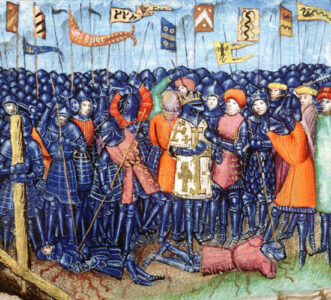
This misuse of the cross to support a secular political effort is reminiscent of the militant Crusaders who affixed the cross to their shields as they rampaged across Western Europe.
Need I say modern evangelical patriots are NOT determined to harm anyone as the Crusaders did. Nevertheless, when the cross is displayed at an event where government property is destroyed, attacks on law enforcement personnel take place, and anger is unleashed on dissenters, how is the redemption promise of the Messiah communicated?
My title, “The War on the Cross,” describes how the misuse of the cross by followers of the crucified Messiah clouds our salvation declaration. Rather than zero in on those who reject the good news of salvation, believers in Jesus need to discern how we can be the ones making war on the message of the death of the Suffering Servant.
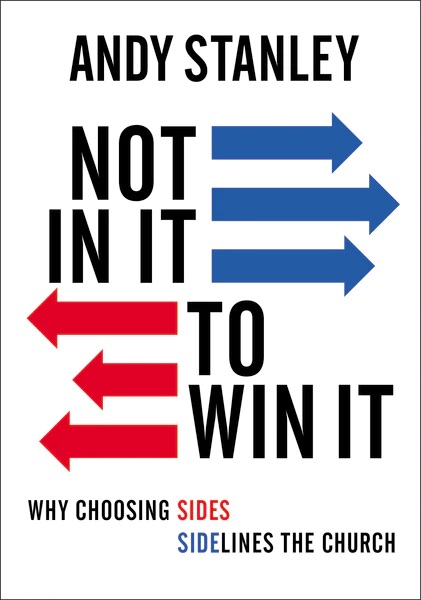
It’s about time! Some evangelical superstar had to say something. We can no longer ignore the gorilla of extreme conservative politics running berserk in today’s evangelical Church. In Pastor Andy Stanley’s book, “Not In It To Win It,” the author boldly goes where most evangelical leaders fear to tread.
The pastor of North Point Church in Alpharetta, GA is exasperated over the current trend of evangelicals who align themselves with right-wing conservative elements. He raises eyebrows in his criticism of pastors, Christian podcasters, and leaders who “lined up behind their political party of choice and leveraged our sacred text to validate political talking points.”
Most importantly, Pastor Stanley recognizes this development is detrimental to the cause of bringing the good news of redemption to all people.
In past generations, Christians broke down our culture into those who know Jesus and those who don’t. Instead, a significant segment of evangelicals has divided our society politically into the Left and the Right.
A few months back, I was amazed listening to a message by modern-day “prophet” and evangelist Mario Murillo in which he stated the “enemy of the Christian is the Democrats.” Even Jesus did not designate the Romans or the Sadducees as enemies of His followers. Yeshua viewed His day’s political and religious parties as lost sheep in need of salvation, not ideological adversaries.
Evangelicals have turned a new corner where Jesus’ followers are intent on changing our world through endorsing political efforts, passing laws that reflect conservative principles, and supporting Right-wing candidates regardless of their ties to white Christian nationalism. Stanley points out that Jesus no longer changes lives in this revised evangelical era. Instead, Right-wing political activism is the key to the transformation of our broken society.
The past five years have been extremely challenging since I am not 100% on board with the angry tenor of evangelical conservative politics. I’ve witnessed ridicule and rejection from fellow evangelicals on social media because of my convictions.
Brotherhood in the Lord has been trumped by something or someone else. I sense my spiritual connection to certain Christians is no longer enough.
Nevertheless, I consider myself an independent who embraces the core tenets of conservatism.
We are not here to “win” elections, argues Stanley, but for a greater purpose: to radiate the love and compassion of Yeshua to bring non-believers to His redeeming power.
The key takeaway points I gained from “Not In It To Win It” (NIITWI), in addition to my observations, are as follows:
*Evangelicals have shifted the focus from sharing the good news to supporting political causes
*Evangelicals have opted to cancel fellow Christians who do not align with their conservative political viewpoint
*Evangelicals are placing their trust in political activism to change America’s culture more than the power of the Messiah Jesus
*Evangelicals have little issue aligning themselves with Right-wing politicians and talk show media stars who have the reputation of being white nationalist and even antisemitic
*Evangelicals have revised the Christian message as one bent on saving America rather than Americans.
*Evangelicals have no biblical basis for espousing the idea God made a covenant with America.
In Matthew 3:2 the prophet John the Baptizer in the New Covenant admonished his fellow Jewish seekers, “Repent, for the kingdom of heaven is at hand.” Today many evangelicals have revised John’s call to prepare oneself for the coming of God’s kingdom on earth. Today Matthew 3:2 has been revised to say, “Vote, for the kingdom of God is at hand.”
Automaker Henry Ford hired electrical genius Charlie Steinmetz to build the generators for his factory. One day the generators came grinding to a halt, and the technicians couldn’t find the problem. Ford called Steinmetz, who tinkered with the machines for a few hours and then threw the switch. The generators whirred to life–but Ford got a bill for $10,000 from Steinmetz. Flabbergasted, the rather tightfisted car maker inquired why the bill was so high.
Steinmetz’s reply: For tinkering with the generators, $10. For knowing where to tinker, $9,990. Ford paid the bill (Today in the Word, MBI, April 1990, p. 27.).
Today we place more value on our unproductive, frantic efforts than the wisdom involved in “knowing where to tinker.” After all, “knowing where to tinker” is more than a mere indicator of knowledge, but a sign of wisdom. Anyone can offer a reasonable guess regarding the nature of a problem we are facing. However, it takes wisdom to know how to apply that speculation and make a wise choice that leads to a resolve.
Nested in the midst of the books of Wisdom (Job, Psalms, Proverbs, Song of Solomon, Ecclesiastes) is a goldmine of biblical counsel for learning how to live skillfully. King Solomon’s Book of Proverbs is a much neglected biblical work that contains timeless truths that show us “where to tinker” in the major issues we face everyday.
One of the areas where followers of Jesus are forever tinkering in trying to determine God’s will. Christians spend precious time in this endless and often fruitless pursuit. Good news! The Book of Proverbs is God’s guidebook for finding His will. This is the major source in the Scriptures that reveals not merely the information about God’s will, but discloses “where to tinker.”
Once we have read and understood this work of wisdom, we will no longer need to speak of “discovering God’s will.” His plan for our lives becomes more apparent the deeper we dig within Solomon’s volume of wisdom.
Besides being a manual that enables us to understand the ways of God, the Book of Proverbs describes the qualities of spiritual character. As we will discover in Solomon’s sayings, possessing spiritual character goes hand-in-hand with grasping the will of God. (more…)
The question of forgiving one another has plagued me ever since I became a follower of Jesus. I heard many pastors and Bible teachers comment on this subject, but I did not feel they were teaching the message of the biblical text. Instead, what I was hearing was helpful common sense advice and psychological healthy ways to look at the way we should forgive one another.
Recently a good friend of mine whom I deeply respect, challenged me on my beliefs regarding the need for repentance as a condition for forgiveness.
Where I agree on this issue with my friend is that we both are in harmony that for a person to be reconciled with God, there must be a display of contriteness or repentance to experience the eternal forgiveness of God. This is designated “vertical forgiveness” because it takes place between man and God.
Forgive One Another
Where my friend and I disagree is whether or not repentance is necessary when we as humans forgive one another. If I offend another person, do I need to go to that person or have that person come to me so that I can confess my sin, state my intention to repent and ask for that person’s forgiveness?
My friend’s viewpoint is that we can forgive the other person through the forgiveness Jesus obtained for us through His death on the cross. The grace of God shown in the sacrificial death of Yeshua on the cross should so overwhelm us, that the natural outflow of our awe towards God’s love is to forgive others because God has shown His merciful forgiveness to us through His Son.
There is not always the need for repentance when there is “vertical forgiveness.” On the basis of the atonement we have in the Messiah, we forgive one another. with or without any display of repentance. In the Sermon on the Mount, in the Lord’s prayer in Matthew 6:12, we read, “And forgive us our debts, as we also have forgiven our debtors (NIV). (more…)
Jun 25, 2014
Posted by Scripture Solutions on Jun 25, 2014 | Comments Off on Did Those Six Million Jews Die for You?
By now the controversy surrounding the Jews for Jesusvideo “That Jew Died for You” has simmered down. Still the strong negative reaction by the Jewish community to the JFJ evangelistic effort remains a stain on Jewish-Christian relations.
At the release of the video prior to Holocaust Remembrance Day, a Jews for Jesus press release, explained the video seeks “to help redefine the conversation and reshape views of Jesus and His relationship to the Holocaust.”
The intentions of JFJ in the production of this video were honorable and aimed to initiate conversation among Jewish people regarding Christianity’s relationship to the murder of six million Jews under the evil Nazi regime.
David Brickner, Executive Director of JFJ offered his public commentary on the video, “The horrors of the Holocaust and the 6 million who died has gnawed at the consciousness of Jews for over 60 years. We want Jewish people to understand that the sufferings inflicted at the hands of the Nazi’s were in no way based on the teachings of Jesus (underlining mine). In fact, he suffered and died on our behalf to show us the love of God.”
Oddly, the majority of Jewish people do not think the teachings of Jesus are responsible for the horrors of the Holocaust. Rather, the Jewish community is more concerned with the antisemitic attitudes of Eastern European Christians prior to and during World War II that helped fuel the racist ideology behind the Holocaust. (more…)
Apr 4, 2014
Posted by Scripture Solutions on Apr 4, 2014 | Comments Off on Not All Israel Is Israel Part 3
The controversy over God’s continuation of Israel as a viable nation despite their rejection of Jesus as their Messiah looms large in the Christian church.
Most followers of Jesus are not even aware of the various Christian theologies regarding the Jewish nation. Yet when uninformed evangelicals are exposed to such anti-Israel beliefs such as Replacement Theology (the view that Israel is no longer God’s elect people but replaced by the Church), these Christians are conflicted over what they are hearing and what the Bible teaches.
As a representative of Replacement Theology (though he prefers the term “Fulfillment Theology”) Gary Burge, New Testament professor at Wheaton College, in his book Whose Land? Whose Promises? the author states, “Abraham can become the father of many nations because when Gentiles share in Abraham’s faith, he becomes their father too (Romans 4:16). Physical lineage, therefore, has been spiritualized into a lineage based on faith (emphasis mine). The ‘land of Israel’ is likewise spirtualized now to include the entire world” (pg. 182).
The key concept to focus on from Burge’s theology is, “physical lineage . . . has been spiritualized into a lineage based on faith.” Israel is no longer a physical nation, according to the Wheaton professor, but has become a spiritual entity that one enters into by faith in Christ not by physical heritage through Abraham. If the physical seed has been “spiritualized” then the “physical” is no longer relevant, hence the physical nation of Israel is moot to God’s spiritual program.
The glaring mistake Burge makes is twofold: first, the physical lineage of a member of the nation of Israel never implied the individual within the nation has a relationship with God, and second, within the physical nation of Israel there has always existed a spiritual remnant of Israelites who remained faithful to God. These two truths do not redefined the nation of Israel, but describe the reality of a spiritual remnant within the physical Jewish nation.
In contrast to Gary Burge’s fulfillment theology which pushes aside God’s plan for the physical nation the Apostle Paul teaches that Israel still exists as a nation even after the first coming of the Messiah. In Romans 9:3-4a Paul pleads, “For I could wish that I myself were cursed and cut off from Christ for the sake of my people, those of my own race, the people of Israel.” To Paul, “those of his own race” are “the people of Israel” quite alive and not replaced by or fulfilled in the New Testament church. (more…)
Mar 20, 2014
Posted by Scripture Solutions on Mar 20, 2014 | Comments Off on Not All Israel is Israel Part 2
To many students of the Bible Paul’s comment in Romans 9:6 that “not all who are descended from Israel are Israel” (NIV) sounds very strange. Is Paul saying the part of Israel that is “descended from Israel” is no longer part of the nation known as Israel? Then that would mean the only people who are actually Israelites are Jewish people who believe in Yeshua as Messiah and the “not all who are descended from Israel ” group are no longer members of the Jewish nation. Yet if you follow that logic, any examples of the NT apostles addressing the segment of the Jewish nation who have not accepted Yeshua as Messiah as still “Israel” makes no sense.
Check out these examples from the New Testament:
Acts 2:22: “Fellow Israelites, listen to this:
Acts 2:29: “Fellow Israelites, I can tell you confidently that the patriarch David died and was buried, and his tomb is here to this day.”
Acts 2: 36: “Therefore let all Israel be assured of this: God has made this Jesus, whom you crucified, both Lord and Messiah.”
Acts 3:12: “When Peter saw this, he said to them: “Fellow Israelites, why does this surprise you?”
Acts 3:17: “Now, fellow Israelites, I know that you acted in ignorance, as did your leaders.”
Acts 4:10: “then know this, you and all the people of Israel: It is by the name of Jesus Christ of Nazareth, whom you crucified but whom God raised from the dead, that this man stands before you healed.”
No wonder Christians are befuddled by Paul’s reference to two Israel’s in Romans 9:6.
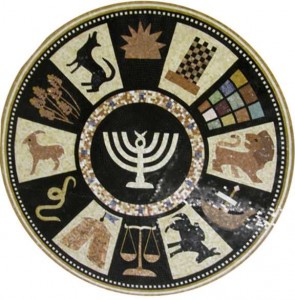
Twelve Tribes of Israel
In light of Paul’s head-scratching use of the phrase, “”not all who are descended from Israel are Israel”, Christian theologians come up with explanations that confuse the issue even more.
My favorite explanation is the one that states unbelieving Israel has been replaced by the Church. This is called “replacement theology.” In this theological system, “Israel” that accepted Yeshua is none other than the Church. Rather than create clarity, Replacement Theology (aka disguised as Fulfillment Theology or Transformation Theology or Promise Theology) contributes more fuzzy thinking since the reader of the New Testament is forced to think “Church” when he reads the term “Israel”. Try to think “Church” in reading Romans 11:26, “and in this way all Israel will be saved.” Thanks, but no thanks. (more…)
Mar 11, 2014
Posted by Scripture Solutions on Mar 11, 2014 | Comments Off on Christ at the Checkpoint Position Paper by Israeli Messianic Jews
1. The Word of God: the Tanakh and the New Covenant Scriptures together, are the one true, infallible, and unalterable standard of truth and life for all believers. As Yeshua our Messiah declared, “Your Word is truth” (John 17:17) and “The Scripture cannot be broken” (John 10:35). Therefore we affirm that “all the promises of God are ‘Yes’” and ‘Amen’ (not abrogated) in Yeshua (II Cor. 1:20), and that “the gifts and calling of God” for His chosen people, Israel, “are irrevocable” (Romans 11:28b-29 in context). “God has not rejected his people whom he foreknew!” (Romans 11:2). Rather, “to them belong [present tense!] the adoption as sons, the glory, the covenants, the giving of the law, the temple worship, and the promises” (Romans 9:4).
2. The Messiah Yeshua’s calling for His Body — in the Land of Israel and throughout the world — is to “make disciples of all the nations” (Matthew 28:19) by proclaiming “repentance for the forgiveness of sins…in His name to all nations” (Luke 24:47). Every movement or activity which does not promote or which, on the contrary, distracts us from that central purpose and calling is not of God, no matter what biblical or spiritual language may be used to describe it. Yeshua never commanded, or even suggested, that His followers were to “bring in” the Kingdom of God on earth. Yeshua Himself promised to establish His Kingdom upon His return (Matthew 25:31, 34), and we, who are heirs of His Kingdom and proclaimers of it in the present age (James 2:5; Acts 28:23, 31), are instructed to pray for that day to quickly come (Matthew 6:10; cf. Philippians 3:20-21).
3. Christ at the Checkpoint is, therefore, a false messianic movement, arrogating to itself the role of Messiah in establishing the Kingdom while promoting a humanistic, political “liberation theology.” [All the “evangelical” CatC speakers reflect the same approach and goals, as is evident from the Kairos Document which Yohanna Katanacho, CatC Committee member, helped compose and Bethlehem Bible College endorsed]. Although cloaking its “mandate” in biblical language (“the teaching of Jesus on the Kingdom of God”) and using seductively positive terms (“Peace, justice, and reconciliation”), this movement has one overriding purpose: to sway Evangelical believers worldwide away from belief in the eternal promises of God to Israel by slandering the Jewish people and delegitimizing the Jewish state; painting Israel as a wicked, oppressive, apartheid “entity”—especially in contrast to the supposedly ‘democratic, tolerant and peace-seeking’ Palestinian Authority and people. There is no Gospel here! (more…)
Mar 26, 2013
Posted by Scripture Solutions on Mar 26, 2013 | Comments Off on Not All Israel Is Israel Part 1
Is “replacement theology” becoming the newest fad among Christian? Lately I run across more and more Christians who claim the Church has replaced Israel as God’s people. The sad thing is that most of them don’t know why they believe what they claim. As I dig deeper speaking with these individuals, they all share the same defect – they are sadly deficient in their knowledge of the Jewish Scriptures.
For those who teach Israel has been replaced by the Church, Romans 9:6 is an essential verse in their arsenal. On the surface, the verse can be confusing. The verse reads, “For not all who are descended from Israel are Israel.” It’s like saying, “Not all players wearing a LA Dodger uniform on the field at Dodger Stadium and sitting in the dugout are really Dodgers.”
The replacement theologian would say, “Not all Jewish people who are wearing the Jewish uniform and sitting in the Jewish dugout are really members of the team. In fact, the real Jews consist of members of the Church who have placed their faith in Jesus as the promised Messiah.”
Replacement theology can be very confusing. If you follow their line of thinking, in some passages “Israel is the Church” and in other texts, “Israel is the Jewish nation.” Israel keeps switching leagues. Sometimes they are in the National League; then at other times they are in the American League. I don’t know who to root for because I don’t know who is who.
Jews for Jesus Director David Brickner has an online conversation with John Piper, author and pastor of Bethlehem Baptist Church in Minneapolis and speaker at Christ at the Checkpoint Conference. This online conversation centers on the Jewish people’s divine right to the land of Israel. ScriptureSolutions highly recommends to its readers to check out these articles and read the Christian ZIonism side represented by Brickner and the anti-Christian Zionist side purported by John Piper.
This is part three of a four-part discussion between Bethlehem Baptist Church pastor John Piper and Jews for Jesus executive director David Brickner on the relationship and attitudes American Christians should have toward Israel. See Brickner’s initial letter and Piper’s first response.
Dear John,
Thank you for your insightful comments on a number of the issues brought up in my first letter to you, many with which I happily agree. We both uphold the need and priority of Jewish evangelism as integral to world mission. We both affirm the ongoing election of Israel (the Jewish people) and God’s faithfulness to his covenant people and his promises. We both look forward to the second coming of Jesus and his glorious restoration of all things, including his people Israel. I do want to take issue with two of your comments before voicing my main concern.