Next, we spring over to the Book of Matthew to see how this former tax collector employed the messianic prophecy of Zechariah. We immediately detect the same issues we discovered in our previous investigation of Zechariah 9:9.
Famous statue in the centre of Bremen, Germany, depicting the donkey, dog, cat and cockerel from Grimm’s famous fairy tale The Bremen Town Musicians Darren Baker | Dreamstime.com
Did Jesus ride on one animal or two? Did He mount them separately or both simultaneously?
I like the common-sense approach to these questions that Louis A. Barbieri Jr. offers in the Bible Knowledge Commentary:
“Only Matthew mentioned a donkey along with the colt. A simple explanation of what some call a contradiction is that when Jesus rode the colt, the mother donkey naturally went along.” (Matthew 21:7 ESV) (Louis A. Barbieri Jr., Matthew, The Bible Knowledge Commentary, 1983, paragraph 21163).
Hence, Jesus entered the holy city with two donkeys, but He rode only one.
This explanation, offered by Louis A. Barbieri Jr., is full of practical wisdom. I’m ready to consider this dilemma solved. But life is never that simple.
It is unsurprising that, despite this straightforward explanation, Bible students want to argue other positions. In the rest of this section, we will indulge some of our contrarian friends.
Growing up in New Jersey as a seven-year-old was an East Coast dream. Swimming at the sunlit Jersey shore. Fishing in northern Jersey lakes. Strolling through New York’s Times Square. I was a dyed-in-the-wool Jersey boy.
No New Jersey summer was complete without the family visit to Atlantic City’s Steel Pier. Of course, I spent the day dogging my parents about when we would attend Steel Pier’s diving horses extravaganza.
Who wouldn’t be thrilled to watch a woman on horseback plummet 40 feet into a water tank?
The Roy Rogers Rodeo was another contender for my attention. At this Western round-up in New York’s Madison Square Garden, I fantasized I would become the first Jewish buckaroo.
Unfortunately, my parents were adamant that horseback lessons should take a rear saddle to my Bar Mitzvah preparations.
Every winter, my Mom and Dad would ferry my brother and me through the Lincoln Tunnel to attend the Barnum and Bailey Circus at MSG. I always looked forward to the clown acts, but loved the daredevil horseback stunts most.
My favorite horseback riding trick is known as Roman riding. A performer stands or balances on the backs of two horses driven abreast, taking hurdles or performing other stunts.
I was always convinced these dazzling skills only belonged in the three rings or a riding arena. Yet I was recently briefed that Jesus may have performed a daredevil balancing act when He paraded into Jerusalem on what some believe was two donkeys.
Messiah’s Unusual Entrance into Jerusalem
I recently encountered this dilemma surrounding Yeshua’s Triumphal Entry while teaching a seminar on the messianic prophecies in the Gospel of Matthew. I was expounding on Yeshua’s entrance into Jerusalem in fulfillment of the messianic passage in Zechariah 9:9, which reads:
“Rejoice greatly, O daughter of Zion! Shout aloud, O daughter of Jerusalem! Behold, your king is coming to you; righteous and having salvation is he, humble and mounted on a donkey, on a colt, the foal of a donkey “ (Zechariah 9:9 ESV).
In Matthew 21:5-7, the gospel writer quotes from the Minor Prophet Zechariah to show how Yeshua’s jaunt into the holy city fulfills this prophecy:
“Say to Daughter Zion, ‘See, your king comes to you, gentle and riding on a donkey, and on a colt, the foal of a donkey.’ ” The disciples went and did as Jesus had instructed them. They brought the donkey and the colt and placed their cloaks on them for Jesus to sit on” (Matthew 21:5-7 NIV11).
In the NIV and the KJV’s translation of Zechariah 9:9, the Messianic King rides into the holy city on two donkeys. In stark contrast, in most English translations of Zechariah 9:9, the Messiah journeys into a rejoicing Jerusalem on one donkey.
Unsurprisingly, a class member raised her hand to inquire about this quizzical discrepancy in the Matthew text. The student wondered, “Why does Matthew record two donkeys, a mother and a young colt? Didn’t Zechariah prophecy that the Messiah would ride on ONE donkey?
The student questioned further, “Matthew also recorded that Jesus sat on THEM. Did Yeshua sit on BOTH the mother donkey and her colt simultaneously?”
The picture this Bible student was portraying turns Yeshua’s entry into Jerusalem into quite a spectacle. Did He ride on the donkeys both at the exact moment or one at a time? I did not have an immediate response.
I knew my understanding of this passage required more research
I also encountered another quandry about the Triumphant Entry. Was Yeshua’s entry into Jerusalem actually “triumphant”?
Pastors often claim Jesus journeyed into Jerusalem to claim Himself as the long-awaited King of Israel. Initially, the Jewish crowds accepted Jesus’ victorious entry four days before Passover. But later in the week, the “same” crowds cried for Yeshua’s crucifixion.
Was Yeshua’s journey into the city of David a victorious military event? Did the crowd misunderstand Yeshua’s message in His memorable entry before His crucifixion?
I decided to do a deep dive into the messianic prophecy of Zechariah 9:9. Then, I would spring over to Matthew 21 to further investigate this possible biblical juggernaut. The results of my private investigation are found in this article.
For I know the plans I have for you, declares the LORD, plans for welfare and not for evil, to give you a future and a hope.
Jeremiah 29:11 ESV
In the film documentary American Gospel writer and director Brandon Kimber shares a sampling of the messages coming out of the Prosperity Gospel movement. In one video segment Pastor Joel Osteen punches out a message in which he asks, “Who told you you can’t accomplish your dreams? God has His plans for you. Your destiny is calling out. It’s time to start living large.” In another sermon Osteen counsels, “I’m asking you to feel good about who you are.”
The focus of Osteen’s message in these video slices is not fixed on the person of Jesus. Rather the youthful Osteen concentrates on self-fulfillment and the belief God will enable us to realize the American Dream of prosperity and accomplishing our personal plans and goals. A message like this often latches on to Jeremiah 29:11 as a passage that guarantees God will enable you to attain your hopes and dreams.
Image by 3D Animation Production Company from Pixabay
As we dive deeper into the Jeremiah passage, we learn the prophet’s message has little to do with actualizing one’s private ambitions. Jeremiah is not promising modern Christians that God will grant His children all aspects of the American Dream.
When Jeremiah 29:11 is misapplied in this manner, the intent of the text is tossed aside to make the words of the prophecy fit an entirely different situation. Then the Scriptures become a source text for people to quote as they wish depending on the situation. Rather than allow the Scriptures to shape our spiritual values and our attitudes towards materialism, we bend the Word of God to our own aspirations as demonstrated in the aberrant teaching of the prosperity huckster Joel Osteen.
Furthermore, in the American Gospel Dr. Julius Kim, Professor of Practical Theology at Westminster Seminary California notes the harm done when the central focus on the New Testament message becomes self-fulfillment, healing and prosperity,
“We’re seeing a church in America that is becoming ultimately Christless. When we believe in a gospel thinking it is all about us, we miss Jesus’ words entirely.”
Dr. Julius Kim, Westminster Seminary California
In fact, the recipients of Jeremiah 29:11 would have been aghast at how this prophetic promise has been misunderstood and misused by modern followers of God. Sadly, the reason why the prosperity gospel is so popular is that most Bible teachers and pastors refuse to correct and call out these questionable teachers.
Today, many Christian leaders succumb to the immaturity of Christians who come out in droves to hear a carnal prosperity message. Somewhere along the line these neophyte believers were taught incorrectly. As a result, their hearts are more fixed on God’s blessings, rather than on God Himself. Once a follower of Yeshua locks into a lifestyle of seeking gifts over and above the gift giver, they are ripe for deception.
For I know the plans I have for you, declares the LORD, plans for welfare and not for evil, to give you a future and a hope.
Jeremiah 29:11 ESV
Introduction
Prior to my acceptance of Yeshua as Messiah of Israel and Redeemer, I embraced several Eastern faiths. I was hunting for a connection to God. To find true peace, some paths required I subjugate my cravings that were in the way of experiencing inner tranquility. Eventually, I was no longer bothered by material things I could not afford or the circumstantial setbacks I experienced. Maintaining my inner calm became a greater priority than getting rattled by temporary frustrations.
Soon I embarked into the world of New Testament Christianity. The evangelical sphere I observed split into two avenues. One lane beckoned me to take the words of Jesus seriously when He called His followers to a life of self-denial. This road involves serving God and others even in the midst of difficult times. In the course of enduring life’s obstacles with God’s strength, the follower of Yeshua finds divine peace and joy.
The other route I encountered was the prosperity gospel. In this scenario suffering should NOT be part of the believer’s life. Rather, this scheme teaches God has promised His children a lifestyle of self-fulfillment, physical health and material wealth. The message is positive and promises the Christian freedom from suffering.
The question must be posed: Which path is the one that most aligns with the teaching of Scripture?
Understand the priority of pursuing God’s kingdom over material blessing
Image by 3D Animation Production Company from Pixabay
According to Matthew 6:33, Jesus taught His disciples, “But seek first the kingdom of God and his righteousness, and all these things will be added to you.” “All these things” refers to the preceding verses in which Jesus describes the concern of God for our material needs-food and drink plus clothing. Jesus does not declare God will provide His followers mansions, several luxury cars in our garage and extravagant vacations. In contrast, because we can trust God to meet our basic needs, we are freed up to seek His kingdom as a priority.
In contrast, many prosperity gospel preachers encourage the Christian to seek “these things” first and then once the person is wealthy and healthy, he or she can experience the kingdom of God. In this world of promised prosperity God exists for me and my needs.
As a result, the Christian enmeshed in this teaching no longer becomes more like Jesus, but he or she is transformed into a materialistic person with skewed priorities. It is my observation this prosperity-focused movement has ignored a lack of spirituality that has crept into the Body of Messiah. The reason? The focus of this teaching is on the believer’s selfish desires and not on establishing the priority of the kingdom of God.
Grasp the true meaning of happiness defined by Scriptures
In no way am I promoting the idea the follower of Yeshua cannot find lasting happiness in this earthly world. My concern is determining what exactly is the happiness God wants for us.
Sadly, some faith teachers offer little qualification of what prosperity and happiness means. The unsuspecting Christian is led to believe that the promised happiness is defined by the materialistic pursuits of our contemporary culture, not by the Word of God. For this reason, believers are open targets for erroneous thinking about what true happiness is.
It is a fair question to ask ourselves, “Is my contentment based on the secular American Dream or by a blessedness defined by Scriptures?”
After all, fulfilling the American dream does not always bring us lasting enjoyment. According to Jonathan T. Pennington, in The Sermon on the Mount and Human Flourishing, he observes, “Wisdom literature such as Psalms and Proverbs often depicts the foolishness, shortsightedness, and ultimately short-lived and destructive nature of ungodly pleasures that promise no lasting happiness” (pg. 295). If we are deadset on grabbing our “best life now,” how are we any different from the unbeliever who cherishes the same pleasures? Does God bring us into a relationship with Him so we can scarf up all the material benefits we can fit into our earthly suitcases? Where is the discernment to see material blessings are a by-product of seeking God and not the goal of seeking God (Matthew 6:35-34)?
Later in this blog post we will gain more insight into the enjoyment we can expect from the Lord. For now let us be cautious to not allow secular thinking define for us what is lasting happiness.
Zero in on the place of blessing during our times of hardship
We should not overlook the future aspect of the blessings God wants to give us. Pennington frames this concept from the New Testament where God is “bringing His kingdom from heaven to earth, vanquishing His enemies and establishing justice and peace between people and all of creation” (Pennington, The Sermon on the Mount and Human Flourishing, pg. 296). In other words, there is a “not yet” aspect of God’s promised blessedness.
Hence, we await the coming of God’s kingdom to grant us lasting happiness on earth, not only in heaven. Jesus describes the “not yet” aspect of spiritual joy on earth in the Lord’s Prayer, “Your kingdom come, your will be done, on earth as it is in heaven (Mathew 6:10).
Why speak a prayer about the future coming of God’s kingdom on earth if we believe the kingdom has come with all its blessings right now? In other words, how can we receive our best life now if God tells us the “best life” is ahead of us and awaiting the Second Coming?
Often the blessings we receive from God in this world are found in the midst of suffering and brokenness. In a strong sense, the follower of Jesus lives in a paradox: we encounter loss, longing, suffering and even persecution along with spiritual happiness, joy and peace. Paul writes, “For it has been granted to you that for the sake of Christ [Messiah] you should not only believe in him but also suffer for his sake” (Philippians 1:29). The inclusion of suffering in the spiritual life is also described in Phillipians 3:8, “Indeed, I count everything as loss because of the surpassing worth of knowing Christ [Messiah] Jesus my Lord. For his sake I have suffered the loss of all things and count them as rubbish, in order that I may gain Christ [Messiah]”.
What we need is a more balanced approach to what it means to find happiness that is not tied into grabbing as much of the American Dream as possible.
To establish the basic tenets of the health and wealth message, the faith teachers gravitate towards biblical passages like Jeremiah 29:11. In this series of articles we have been focusing on understanding the context and audience of this often misused Scripture verse. We must ask, “Who is this promise addressed to? What exactly are the plans God has for His people? How should a modern follower of Jesus apply this verse to their lives?”
My parents both passed away within the last decade. They are buried in a Jewish cemetery in North Lauderdale, Florida. Whenever I am in the Sunshine State, I make every effort to show my respect and visit their gravesites.
I find it a bewildering experience to observe the engravings on the grave stones in this memorial park. Some headstones illustrate that the departed were avid gamblers. On their markers are carved images of dice, playing cards, roulette wheels and cocktail glasses. The only thing missing is whether after thirty years of gambling, they came out ahead or died with a heavy debt.
Why would someone who lived for almost a century desire to be known for their gambling passion? What kind of legacy are they passing on to their loved ones?
In this article we look at Noah, a man who left us a legacy of faithfulness to God in the midst of an impending worldwide disaster. He has many descriptions written about him in Scripture that chronicle how he handled the universal crisis that confronted him. Any one of these statements could have been written on his tombstone: a man who “found favor in the eyes of the LORD (Genesis 6:8); “a righteous man, blameless in his generation . . . walked with God” (Genesis 6:9); “an heir of the righteousness that comes by faith” (Hebrews 11:7) and a “herald of righteousness” (2 Peter 2:5).
Noah left us an example of how we can conduct ourselves when life does not meet our expectations. Yes, there are vast differences between ourselves and Noah that impede us from drawing an exact parallel. Yet there are some spiritual attitudes possessed by this patriarch that can help us during the current COVID-19 crisis of crippling economic deprivation, extreme health hazards and separation from loved ones.
Summers in the East Coast were often a treat for me as a young boy. I treasured spending those hot, humid days visiting my grandparents in Coney Island in New York. Besides cooling off in the Atlantic Ocean, the main attraction was Steeplechase Park. The assortment of rides this park offered to a young starry-eyed boy was dizzying. Of course, I was ambitious enough to think I could enjoy them all in one outing.
One go-to amusement was the swing ride. According to an online history of carousels, the “swing ride is a variant of a carousel ride – a fairground ride that has chairs suspended by chains from the top of the carousel . . . This ride is also called a swing carousel, wave swinger, yo-yo, Chair-O-Planes or a swinger”.
This mechanism operates on a principle of a spinning central core powered by a motor that forces the swings to extend outward on wires or metal chains. The faster the central core spins, the farther out the swings stretch.
What does this sentimental childhood memory have to do with Noah’s situation or any spiritual truths? Let me suggest our relationship with God begins with a person’s central core fixed on the Lord. From this connection to our Creator, we discover a powerful, inner centrifugal force that drives our spiritual aspirations. When that inner connection to God is fractured, there are grave spiritual consequences-lack of purpose, extreme self-centeredness, depression, broken relationships, and involvement in destructive sins. This truth brings us to the reason why God brought the Flood upon our planet.
Sadly, this catastrophic event in Noah’s day was due to man’s lack of any desire to enjoy a relationship with God. The human population refused to see their need to have God as that centrifugal force. Instead, they attempted to enthrone themselves at the core of their souls. We too are fooled by the same self-deception. As long as we keep the swings in motion, we are convinced we can be the “captain of our own souls.” Despite our sincere endeavors, we default to arrogant pride, extreme self-centeredness, and a refusal to believe there is Someone in the universe greater than ourselves.
From this breakdown in man’s bridge to God in Noah’s day, humanity spiraled out of control. The downward thrust of mankind was enough for God to respond with a promise of a worldwide Flood. Like the motion of the carousel swing ride from the central core, our trouble is due to a failure to see the need to allow God to become part of our energizing inner core.
By now the controversy surrounding the Jews for Jesusvideo “That Jew Died for You” has simmered down. Still the strong negative reaction by the Jewish community to the JFJ evangelistic effort remains a stain on Jewish-Christian relations.
At the release of the video prior to Holocaust Remembrance Day, a Jews for Jesus press release, explained the video seeks “to help redefine the conversation and reshape views of Jesus and His relationship to the Holocaust.”
The intentions of JFJ in the production of this video were honorable and aimed to initiate conversation among Jewish people regarding Christianity’s relationship to the murder of six million Jews under the evil Nazi regime.
David Brickner, Executive Director of JFJ offered his public commentary on the video, “The horrors of the Holocaust and the 6 million who died has gnawed at the consciousness of Jews for over 60 years. We want Jewish people to understand that the sufferings inflicted at the hands of the Nazi’s were in no way based on the teachings of Jesus (underlining mine). In fact, he suffered and died on our behalf to show us the love of God.”
Oddly, the majority of Jewish people do not think the teachings of Jesus are responsible for the horrors of the Holocaust. Rather, the Jewish community is more concerned with the antisemitic attitudes of Eastern European Christians prior to and during World War II that helped fuel the racist ideology behind the Holocaust. (more…)
Mar 11, 2014
Posted by Scripture Solutions on Mar 11, 2014 | Comments Off on Christ at the Checkpoint Position Paper by Israeli Messianic Jews
1. The Word of God: the Tanakh and the New Covenant Scriptures together, are the one true, infallible, and unalterable standard of truth and life for all believers. As Yeshua our Messiah declared, “Your Word is truth” (John 17:17) and “The Scripture cannot be broken” (John 10:35). Therefore we affirm that “all the promises of God are ‘Yes’” and ‘Amen’ (not abrogated) in Yeshua (II Cor. 1:20), and that “the gifts and calling of God” for His chosen people, Israel, “are irrevocable” (Romans 11:28b-29 in context). “God has not rejected his people whom he foreknew!” (Romans 11:2). Rather, “to them belong [present tense!] the adoption as sons, the glory, the covenants, the giving of the law, the temple worship, and the promises” (Romans 9:4).
2. The Messiah Yeshua’s calling for His Body — in the Land of Israel and throughout the world — is to “make disciples of all the nations” (Matthew 28:19) by proclaiming “repentance for the forgiveness of sins…in His name to all nations” (Luke 24:47). Every movement or activity which does not promote or which, on the contrary, distracts us from that central purpose and calling is not of God, no matter what biblical or spiritual language may be used to describe it. Yeshua never commanded, or even suggested, that His followers were to “bring in” the Kingdom of God on earth. Yeshua Himself promised to establish His Kingdom upon His return (Matthew 25:31, 34), and we, who are heirs of His Kingdom and proclaimers of it in the present age (James 2:5; Acts 28:23, 31), are instructed to pray for that day to quickly come (Matthew 6:10; cf. Philippians 3:20-21).
3. Christ at the Checkpoint is, therefore, a false messianic movement, arrogating to itself the role of Messiah in establishing the Kingdom while promoting a humanistic, political “liberation theology.” [All the “evangelical” CatC speakers reflect the same approach and goals, as is evident from the Kairos Document which Yohanna Katanacho, CatC Committee member, helped compose and Bethlehem Bible College endorsed]. Although cloaking its “mandate” in biblical language (“the teaching of Jesus on the Kingdom of God”) and using seductively positive terms (“Peace, justice, and reconciliation”), this movement has one overriding purpose: to sway Evangelical believers worldwide away from belief in the eternal promises of God to Israel by slandering the Jewish people and delegitimizing the Jewish state; painting Israel as a wicked, oppressive, apartheid “entity”—especially in contrast to the supposedly ‘democratic, tolerant and peace-seeking’ Palestinian Authority and people. There is no Gospel here! (more…)
Mar 26, 2013
Posted by Scripture Solutions on Mar 26, 2013 | Comments Off on Not All Israel Is Israel Part 1
Is “replacement theology” becoming the newest fad among Christian? Lately I run across more and more Christians who claim the Church has replaced Israel as God’s people. The sad thing is that most of them don’t know why they believe what they claim. As I dig deeper speaking with these individuals, they all share the same defect – they are sadly deficient in their knowledge of the Jewish Scriptures.
For those who teach Israel has been replaced by the Church, Romans 9:6 is an essential verse in their arsenal. On the surface, the verse can be confusing. The verse reads, “For not all who are descended from Israel are Israel.” It’s like saying, “Not all players wearing a LA Dodger uniform on the field at Dodger Stadium and sitting in the dugout are really Dodgers.”
The replacement theologian would say, “Not all Jewish people who are wearing the Jewish uniform and sitting in the Jewish dugout are really members of the team. In fact, the real Jews consist of members of the Church who have placed their faith in Jesus as the promised Messiah.”
Replacement theology can be very confusing. If you follow their line of thinking, in some passages “Israel is the Church” and in other texts, “Israel is the Jewish nation.” Israel keeps switching leagues. Sometimes they are in the National League; then at other times they are in the American League. I don’t know who to root for because I don’t know who is who.
I thought the issue of whether or not Jesus was married was settled when Dan Brown’s fiction book, The Da Vince Code, often taken as non-fiction, was debunked by one conservative biblical scholar after another. Yet the conjecture Jesus had a wife does not seem to ever want to go away.
In The Da Vince Code the author relied heavy on third and fourth century Gnostic texts to concoct his unprovable premise that Jesus and Mary Magdalene were married, and together brought a child into the world, Jesus Jr. According to Brown and Michael Baigent’s Holy Blood, Holy Grail (the true literary source for Brown’s plagiarised work), Mary Magdalene took the “Jesus child” out of Israel to protect her treasured progeny and made off to France. The child grew up, married and fathered a child whose descendants married into the French royal line and, after several generations, engendering the Merovingian dynasty.
Dan Brown’s hypothesis bears no biblical evidence and lacks historical proof as many biblical researchers exposed during the “Da Vince Code” mania that grabbed the attention of the biblically illiterate who would rather believe a Hollywood film over the historical veracity of the Bible. Yet somehow Tom Hanks, who starred in the film production is more credible than Matthew, Mark, Luke and John!
The “Wife of Jesus” Papyrus Revealed
Recently Harvard Divinity School historian of early Christianity Karen L. King announced she has come across an ancient papyrus fragment from the fourth century that, when translated, appears to indicate that Jesus was married.
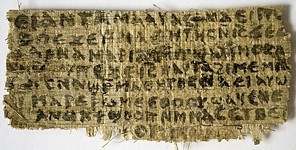
Coptic papyrus fragment claims Jesus was married
An article in the Huffington Post on this discovery states:
The text is being dubbed “The Gospel of Jesus’ Wife.” The part of it that’s drawing attention says, “Jesus said to them, ‘my wife'” in the Coptic language. The text, which is printed on papyrus the size of a business card, has not been scientifically tested to verify its dating, but King and other scholars have said they are confident it is a genuine artifact.
Concerning the controversial section of the text, the Huffington Post records:
The quote about Jesus’ wife is part of a description of a conversation between Jesus and his disciples. In the conversation, Jesus talks about his mother twice and speaks once about his wife. One of them is identified as “Mary.” His disciples discuss whether Mary is worthy of being part of their community, to which Jesus replies, “she will able to be my disciple.”
In her presentation about the Coptic fragment King admits the papyrus does not prove Jesus was married. What it does prove, according to King, is that the debate about Jesus’ marital status was present in the early formation of Christianity. In fact, in order to give credence for those who advocated celibacy as the highest state of purity, many Christians appealed to Jesus’ unmarried status.
The Description of the Coptic Fragment
The fragment only has eight incomplete lines of text on one side and additional barely legible lines on the other side showing only three faded words. The text is written in the Coptic language rather than Koine Greek, so it is a copy of an earlier version or an original penned in the fourth century. King claims it is from a second century Greek text but offers no proof.
Along with Karen King, Princeton University professor Anne Marie Luijendijk and Roger Bagnall, director of the Institute for the Study of the Ancient World, claim they have confirmed the document is valid.
So what should Christians make of this most recent discovery of a papyrus fragment from the fourth century that claims Jesus was married? Was Jesus married? If so, and this fact was deliberately or inadvertently left out of the New Testament records of the life of Jesus, does this then cast doubt on the accuracy of the four gospels and their writers?
The Debunking of the Gospel of Jesus’ Wife
First, the document is from the fourth century. Four hundred years after Christ lived on earth. How can writers in four hundred years later know more than the eyewitnesses who lived with Jesus three years and knew His life on a daily basis?
Second, the dating is not verified yet, but give or take a fifty or one hundred years we are dealing with a document 300-400 years removed from Jesus’ historical appearance on earth. I find the historical method used by King to be highly unusual.
When asked where did the papyrus come from. King answered, “We don’t know. . . nothing is known about the circumstances of its discovery,” an admission that has raised red flags for other scholars. King speculates the fragment may have been tossed in an ancient garbage heap by someone who objected to the idea of Jesus being married. As a student of biblical history, I am somewhat taken back by King’s unfounded speculation about an historical document about which he is clueless regarding its origins. Instead, this Harvard scholar offers her conjectured opinion based on absolutely nothing.
Third, the Coptic papyrus fragment does not prove Jesus was married. Even King admits the historical artifact is not old enough to prove Jesus was married. The only thing the document proves is that early Christians may have discussed whether Jesus was married.
The Harvard historian is quick to admit that the reference to Jesus’ wife may have been figurative:
King also acknowledged that Jesus might have been speaking figuratively when he referred to “my wife.” After all, the fragment is just 33 words long, with incomplete sentences and very little context.
Fourth, in the fourth century Gnosticism was at its peak in influencing unsuspecting Christians. This is when all those weird gospels made their appearance such as the Gospel of Judas made their contested appearance in Christianity. Gnosticism was always looking for “secret knowledge” and seeks to reveal hidden truth about Jesus previously unknown, hence the entire gnostic influenced premise of the Da Vince Code which has been disproved over and over.
When asked by Huffington Post about what other ancient texts say about Jesus being married, King answered,
The Bible, of course, says nothing about Jesus marrying, though New Testament writers occasionally used the metaphor of the church and God’s people as the “bride of Christ.” Some of the Gnostic gospels — ancient texts unearthed in the 20th century that are not included in the Christian canon — suggest that Jesus had an intimate relationship with Mary Magdalene. The apocryphal Gospel of Philip, for example, says that Jesus kissed Mary, and loved her more than the apostles.
Again, these are unfounded speculations based on documents that came later than the original gospels written by men who knew Jesus.
Fifth, Gnosticism made its appearance in the first century in an elementary form and was refuted by the New Testament writers. They claimed Jesus was pure spirit and did not have a human body. To the Gnostic flesh is evil. I John deal with the fact that to be a believer one must confess Jesus came in the flesh in order to be a true believer.
I John 4:1-3 refutes early gnosticism:
Dear friends, do not believe every spirit, but test the spirits to see whether they are from God, because many false prophets have gone out into the world. This is how you can recognize the Spirit of God: Every spirit that acknowledges that Jesus Christ has come in the flesh is from God, but every spirit that does not acknowledge Jesus is not from God.
Sixth, this is a fragment the size of a business card. Are you going to trust the four books of four eyewitnesses who lived with Jesus or a fragment from a papyrus?
Seventh, Harvard professor Karen King is a specialist in Gnosticism, “King, who focuses on Coptic literature, Gnosticism and women in the Bible, has published on the Gospel of Judas and the Gospel of Mary of Magdala.” Is it any wonder that these extra-canonical books which contradict the New Testament make their appearance in order to cast doubt on the validity of the New Testament canon. A lot of the teachings in these text contradict the theology and teachings of Jesus and the writers of the gospels and the epistles.
Eighth, if Jesus was married, then when He was on the cross, why did he tell John to only take care of His mother and not His “wife”? Also, the NT lists Jesus’ brothers and sisters, mother and father, his cousin John the Baptizer, and his aunt and uncle Elizabeth and Zacharias. Why wouldn’t his wife be mentioned?
Ninth, the issue raised by the appearance of this Coptic text, despite what King claims, is not celibacy as viewed by early Christians or whether or not Jesus remained chaste. The significance of this “discovery” is whether a Gnostic papyrus fragment the size of a business card written 400 years after Jesus has more authority than the four books of the New Testament by men who knew Him intimately.
For further information on this “wife of Jesus” Gospel, check out BIOLA professor Gary Manning Jr.’s blog.