Jul 6, 2016
Posted by Scripture Solutions on Jul 6, 2016 | Comments Off on Need a foolproof map to guide your life?
“The simple believe anything, but the prudent give thought to their steps.”
Proverbs 14:15 NIV
פֶּ֭תִי יַאֲמִ֣ין לְכָל־דָּבָ֑ר וְ֝עָר֗וּם יָבִ֥ין לַאֲשֻׁרֹֽו׃
Picture a seasoned team of seamen with years of sailing experience making a blunder that practically shipwrecked their vessel. Remarkably, the 19th century polar expedition of the USS Jeannette, commandeered by Lieutenant George De Long ended in complete failure.
Captain De Long and his crew became thoroughly disoriented on their trek—not because of a faulty compass, but because of a mistaken map. De Long’s quest rested on a picture of the North Pole laid out in the maps of Dr. August Heinrich Petermann.
Petermann’s maps prop osed a “thermometric gateway” through the ice that opened onto a vast “polar sea” beyond the ice. As it turned out the ship was sailing to a world that didn’t exist.
Rather than an open polar sea, the crew observed the perilous ice surrounding the ship. Immediately, the erroneous maps were scrapped and replaced with a comprehension of the way the Arctic truly is
Most readers conclude from this account Christians need a foolproof map from God to navigate His will.
Wrong!
I share this dramatic story to explain this is NOT how to identify God’s will.
The Lord does not have a hidden, faultless map to lead us to a treasure chest of priceless doubloons, aka His divine plan.
If there isn’t a GPS to steer us to the Lord’s will, what does Solomon in Proverbs 14:15 instruct us to do or not do to remove the mystery attached to “finding the will of God”. (more…)
Jun 26, 2016
Posted by Scripture Solutions on Jun 26, 2016 | Comments Off on Do You Know When To Keep Your Lips Zipped?
Proverbs 14:3
By the mouth of a fool comes a rod for his back, but the lips of the wise will preserve them. (ESV)
בְּֽפִי־א֭֭וִיל חֹ֣טֶר גַּאֲוָ֑ה וְשִׂפְתֵ֥י ח֝֝כָמִ֗ים תִּשְׁמוּרֵֽם׃
If all our words were put into print, the result would be: a single day’s words would fill a 50-page book, while in a year’s time the average person’s words would fill 132 books of 200 pages each! Among all those words there are bound to be some statements spoken in anger, carelessness, or haste. And someone is sure to get hurt.
Since often I write using my laptop at a variety of Starbuck locations, I am exposed to a myriad of conversations. Loud, obnoxious cell phone calls. Stodgy business conferences. Idle talk meetups. Annoying boardgame banter. I hear it all.
One morning I overheard a young woman on her cell grilling the person on the other end of the line like an CIA operative. Eventually she droned on about her need to “lose fat,” fleshed out every gory details of her recent eye surgery and fished voraciously for every scandalous minutia about some mutual friends. It was painful to witness her unmanaged tongue at work.
To deal with the need to manage our tongues, in Proverbs 14:3 Solomon focuses on the communication of the wise contrasted to the verbiage that pours out of the mouth of a fool.
Speech management is a theme threaded throughout the Book of Proverbs. Solomon continually warns his listeners one area where we demonstrate either wisdom or foolishness is the control of our tongue. (more…)
Jun 21, 2016
Posted by Scripture Solutions on Jun 21, 2016 | Comments Off on Do You Think Before You Act or Just Act?
Proverbs 13:16
In everything the prudent acts with knowledge, but a fool flaunts his folly.
כָּל־ע֭֭רוּם יַעֲשֶׂ֣ה בְדָ֑עַת ו֝֝כְסִ֗יל יִפְרֹ֥שׂ אִוֶּֽלֶת׃
In a San Francisco Examiner (7/7/93) report the California State Automobile Association claims office received a package by Federal Express. The unknown contents were bundled in a Fruit Loops cereal box.
Workers quickly became suspicious. Security guards called the police, and about 400 office workers were evacuated from the building. The bomb squad soon arrived on the scene.
The Fruit Loops cereal box was “neutralized” with a small cannon, and its contents were blasted into the air. The bomb squad, however, found no explosives. Inside the suspicious package was $24,000 in cash. The box contained bundles of $20 bills, $1,000 of which were destroyed in the blast.
The response of the SF police was understandable. A suspicious package arrived that had to be dealt with. Only after the cereal box was neutralized was the identity of the contents determined.
In our world it is necessary to use caution, but acting without more thorough investigation can destroy things more valuable than money.
In Proverbs 13:16 Solomon contrasts the wisdom of taking time to think before one takes action with the foolishness of taking active steps without thinking through one’s options. (more…)
Jun 20, 2016
Posted by Scripture Solutions on Jun 20, 2016 | Comments Off on Proverbs for Living Skillfully
Automaker Henry Ford hired electrical genius Charlie Steinmetz to build the generators for his factory. One day the generators came grinding to a halt, and the technicians couldn’t find the problem. Ford called Steinmetz, who tinkered with the machines for a few hours and then threw the switch. The generators whirred to life–but Ford got a bill for $10,000 from Steinmetz. Flabbergasted, the rather tightfisted car maker inquired why the bill was so high.
Steinmetz’s reply: For tinkering with the generators, $10. For knowing where to tinker, $9,990. Ford paid the bill (Today in the Word, MBI, April 1990, p. 27.).
Today we place more value on our unproductive, frantic efforts than the wisdom involved in “knowing where to tinker.” After all, “knowing where to tinker” is more than a mere indicator of knowledge, but a sign of wisdom. Anyone can offer a reasonable guess regarding the nature of a problem we are facing. However, it takes wisdom to know how to apply that speculation and make a wise choice that leads to a resolve.
Nested in the midst of the books of Wisdom (Job, Psalms, Proverbs, Song of Solomon, Ecclesiastes) is a goldmine of biblical counsel for learning how to live skillfully. King Solomon’s Book of Proverbs is a much neglected biblical work that contains timeless truths that show us “where to tinker” in the major issues we face everyday.
One of the areas where followers of Jesus are forever tinkering in trying to determine God’s will. Christians spend precious time in this endless and often fruitless pursuit. Good news! The Book of Proverbs is God’s guidebook for finding His will. This is the major source in the Scriptures that reveals not merely the information about God’s will, but discloses “where to tinker.”
Once we have read and understood this work of wisdom, we will no longer need to speak of “discovering God’s will.” His plan for our lives becomes more apparent the deeper we dig within Solomon’s volume of wisdom.
Besides being a manual that enables us to understand the ways of God, the Book of Proverbs describes the qualities of spiritual character. As we will discover in Solomon’s sayings, possessing spiritual character goes hand-in-hand with grasping the will of God. (more…)
Nov 7, 2014
Posted by Scripture Solutions on Nov 7, 2014 | 2 comments
The question of forgiving one another has plagued me ever since I became a follower of Jesus. I heard many pastors and Bible teachers comment on this subject, but I did not feel they were teaching the message of the biblical text. Instead, what I was hearing was helpful common sense advice and psychological healthy ways to look at the way we should forgive one another.
Recently a good friend of mine whom I deeply respect, challenged me on my beliefs regarding the need for repentance as a condition for forgiveness.
Where I agree on this issue with my friend is that we both are in harmony that for a person to be reconciled with God, there must be a display of contriteness or repentance to experience the eternal forgiveness of God. This is designated “vertical forgiveness” because it takes place between man and God.

Forgive One Another
Where my friend and I disagree is whether or not repentance is necessary when we as humans forgive one another. If I offend another person, do I need to go to that person or have that person come to me so that I can confess my sin, state my intention to repent and ask for that person’s forgiveness?
My friend’s viewpoint is that we can forgive the other person through the forgiveness Jesus obtained for us through His death on the cross. The grace of God shown in the sacrificial death of Yeshua on the cross should so overwhelm us, that the natural outflow of our awe towards God’s love is to forgive others because God has shown His merciful forgiveness to us through His Son.
There is not always the need for repentance when there is “vertical forgiveness.” On the basis of the atonement we have in the Messiah, we forgive one another. with or without any display of repentance. In the Sermon on the Mount, in the Lord’s prayer in Matthew 6:12, we read, “And forgive us our debts, as we also have forgiven our debtors (NIV). (more…)
Jun 25, 2014
Posted by Scripture Solutions on Jun 25, 2014 | Comments Off on Did Those Six Million Jews Die for You?

The Entrance to Auschwitz
By now the controversy surrounding the Jews for Jesus video “That Jew Died for You” has simmered down. Still the strong negative reaction by the Jewish community to the JFJ evangelistic effort remains a stain on Jewish-Christian relations.
At the release of the video prior to Holocaust Remembrance Day, a Jews for Jesus press release, explained the video seeks “to help redefine the conversation and reshape views of Jesus and His relationship to the Holocaust.”
The intentions of JFJ in the production of this video were honorable and aimed to initiate conversation among Jewish people regarding Christianity’s relationship to the murder of six million Jews under the evil Nazi regime.
David Brickner, Executive Director of JFJ offered his public commentary on the video, “The horrors of the Holocaust and the 6 million who died has gnawed at the consciousness of Jews for over 60 years. We want Jewish people to understand that the sufferings inflicted at the hands of the Nazi’s were in no way based on the teachings of Jesus (underlining mine). In fact, he suffered and died on our behalf to show us the love of God.”
Oddly, the majority of Jewish people do not think the teachings of Jesus are responsible for the horrors of the Holocaust. Rather, the Jewish community is more concerned with the antisemitic attitudes of Eastern European Christians prior to and during World War II that helped fuel the racist ideology behind the Holocaust. (more…)
Jun 22, 2012
Posted by Scripture Solutions on Jun 22, 2012 | Comments Off on How to Treat a Rebellious Israel | Christianity Today
Jews for Jesus Director David Brickner has an online conversation with John Piper, author and pastor of Bethlehem Baptist Church in Minneapolis and speaker at Christ at the Checkpoint Conference. This online conversation centers on the Jewish people’s divine right to the land of Israel. ScriptureSolutions highly recommends to its readers to check out these articles and read the Christian ZIonism side represented by Brickner and the anti-Christian Zionist side explained by John Piper.
How to Treat a Rebellious Israel | Christianity Today.
Are American pastors dismissive of Arab Christians in Israel? Should Christians treat the Israeli-Palestinian dispute differently than other conflicts? As pastor of Bethlehem Baptist Church in Minneapolis, John Piper has been addressing these contentious questions for years. After he began informally discussing them with David Brickner, executive director of Jews for Jesus, we invited them to share some of their discussion with our readers. We continue today with Piper’s response to Brickner’s question, “Do Jews have a divine right to the Promised Land?” and will continue tomorrow with Brickner’s response.

Pastor John Piper
Dear David,
Thank you for taking this happy initiative. I am eager to discuss Israel and the Promised Land with you. I love Jews for Jesus. Your leadership, and Moishe Rosen’s before you, have been for me a cause for continual thanksgiving. “To the Jew first, and also to the Greek” (Rom. 1:16) has never ceased to carry weight with me. I pray we will never lose Paul’s passion in Romans 10:1: “My heart’s desire and prayer to God for them is that they may be saved.”
We both agree that the way God chose to bring all the nations under the sway of King Jesus is astonishing. After sketching it, Paul praised God, “How unsearchable are his judgments and how inscrutable his ways!” (Rom. 11:33). (more…)
Jun 20, 2012
Posted by Scripture Solutions on Jun 20, 2012 | Comments Off on Just Published! Jesus or Yeshua: Exploring the Jewish Roots of Christianity
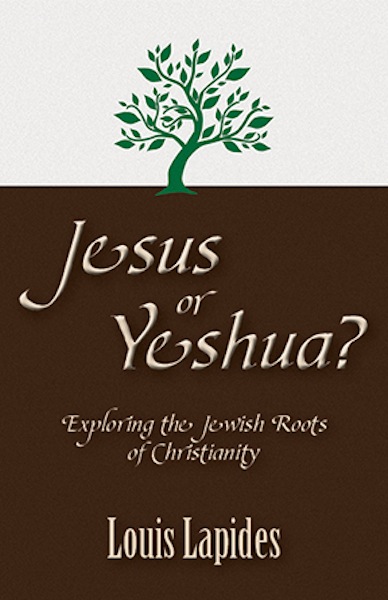
Today ScriptureSolutions published a new booklet written by Louis Lapides. This brief book can be found for Kindle at Amazon.

Jesus or Yeshua: Exploring the Jewish Roots of Christianity by Louis Lapides
It came to no surprise to me that when I first became a Jewish follower of Yeshua, I was going to have a cultural crisis trying to fit into a Gentile Church. I lasted a few months before I started asking inevitable questions, “I’m Jewish. Jesus is Jewish. His first followers were Jewish. The New Testament was written by Jews and a lot of the concepts they discussed have a powerful Hebraic background. Then why is Christianity so “not-Jewish”?
Jesus or Yeshua: Exploring the Jewish Roots of Christianity provides the reader with some of the findings I came upon as searched for answers to my questions. For me a lot of the issues were resolved when I studied the origin of most of the terminology used by Christians when describing their beliefs and practices. When I was growing up attending Hebrew school in preparation for my Bar Mitzvah I never expected that Rabbi Printz would tell me that the mass practiced by the Catholic Church across the street from our temple was actually based in the Jewish Passover. Nor was I told that baptism has it’s origins in the Jewish practice of immersion or mikveh used when Gentiles would turn from their paganism and convert to Judaism.
Attending a church for me at age 23 was a shocker as I describe in my opening chapter. Here is a sample section from that chapter that will give you an idea of what Jesus or Yeshua: Exploring the Jewish Roots of Christianity is all about.
Here’s a shocker . . . Jewish people don’t feel at ease in a Christian church. The first time I attended a Protestant congregation, a Southern Baptist one, I couldn’t avert my eyes from the 10-foot tall stained glass mosaic of Jesus looming behind the pastor. I imagined for a few moments the man from Galilee was about to step out of the window, float over to my pew and ask whether I noticed the “Jews Not Welcome” sign at the church’s front door. “Of course,” I would respond, “But Jesus, aren’t you . . . .?”
(more…)
Nov 14, 2011
Posted by Scripture Solutions on Nov 14, 2011 | 2 comments
Is is possible that a Christian can be too loving? Can a follower of Jesus emphasize the love of the Lord so much that he or she leaves out other essential qualities of the Lord in their theology?
In Lynne Hybels’ recent blog on God’s Politics she asks, “What is an evangelical?” In one of her summary statements, Hybels notes:
I am a Christian today because of what I found in Jesus.
In the lover of my soul and the radical activist, I found the Christianity my mind and my soul had longed for.
In my humble opinion this is what it means to be an evangelical.
But whatever the label, I believe it’s the Christianity that our world desperately needs to see.
Hybels focuses on God’s compassion for others and the compassion of Christians towards other people as the true meaning of what it means to be a Christian. In essence I agree with her. Still I question any Christian writer who focuses mainly on love as the main description of Christianity.
Focusing Only on God’s Love Can Be a Formula for Theological Disaster
If the most important expression of God is love, then what shall we make of the afterlife? Will a loving God go so far as to express His love in such a way as to make sure everyone enters heaven? If God’s chief character is love and His sense of holiness and justice is ignored, then what else can one conclude? If that’s what a person believes, that person is a universalist. He or she believes everyone will be saved. There is no other alternative. How can a God who is all loving send anyone to hell? 
Rob Bell, in his book Love Wins is a universalist as I understand him. In the fourth chapter of his book, he asks whether God gets what He wants? If God wants everyone to be saved, as Bell asserts, then the all powerful God will make sure everyone will be saved. If not, then either God is powerful enough to save us all despite His loving desires or He is not truly loving if He refuses to exercise His power to guarantee everyone a spot in heaven.
Since the Bible does not teach universalism, I interpret this belief as one in which the Christian ends up being too loving.
Since ScriptureSolutions is committed to biblical teaching and preaching, it is important that Christians are hearing the truth being taught from the pulpit. If one’s pastor is teaching universalism then the congregant has every right to ask whether their minister is being faithful to the Word of God.
Salvation Calls For a Personal Decision to Drink the Water of Eternal Life
To prove his position on universalism, Pastor Bell gathers together all the passages that refer to the Lord’s intent to ultimately restore “everything and everybody” (pg. 107). For instance, he quotes from Colossians 1:19-20: “For God was pleased to have all his fullness dwell in him, and through him to reconcile to himself all things, whether things on earth or things in heaven, by making peace through his blood, shed on the cross.” To Bell this verses and others like it provide us the evidence God will be reconciled with all people. (more…)