The question of forgiving one another has plagued me ever since I became a follower of Jesus. I heard many pastors and Bible teachers comment on this subject, but I did not feel they were teaching the message of the biblical text. Instead, what I was hearing was helpful common sense advice and psychological healthy ways to look at the way we should forgive one another.
Recently a good friend of mine whom I deeply respect, challenged me on my beliefs regarding the need for repentance as a condition for forgiveness.
Where I agree on this issue with my friend is that we both are in harmony that for a person to be reconciled with God, there must be a display of contriteness or repentance to experience the eternal forgiveness of God. This is designated “vertical forgiveness” because it takes place between man and God.
Forgive One Another
Where my friend and I disagree is whether or not repentance is necessary when we as humans forgive one another. If I offend another person, do I need to go to that person or have that person come to me so that I can confess my sin, state my intention to repent and ask for that person’s forgiveness?
My friend’s viewpoint is that we can forgive the other person through the forgiveness Jesus obtained for us through His death on the cross. The grace of God shown in the sacrificial death of Yeshua on the cross should so overwhelm us, that the natural outflow of our awe towards God’s love is to forgive others because God has shown His merciful forgiveness to us through His Son.
There is not always the need for repentance when there is “vertical forgiveness.” On the basis of the atonement we have in the Messiah, we forgive one another. with or without any display of repentance. In the Sermon on the Mount, in the Lord’s prayer in Matthew 6:12, we read, “And forgive us our debts, as we also have forgiven our debtors (NIV). (more…)
Jun 25, 2014
Posted by Scripture Solutions on Jun 25, 2014 | Comments Off on Did Those Six Million Jews Die for You?
By now the controversy surrounding the Jews for Jesusvideo “That Jew Died for You” has simmered down. Still the strong negative reaction by the Jewish community to the JFJ evangelistic effort remains a stain on Jewish-Christian relations.
At the release of the video prior to Holocaust Remembrance Day, a Jews for Jesus press release, explained the video seeks “to help redefine the conversation and reshape views of Jesus and His relationship to the Holocaust.”
The intentions of JFJ in the production of this video were honorable and aimed to initiate conversation among Jewish people regarding Christianity’s relationship to the murder of six million Jews under the evil Nazi regime.
David Brickner, Executive Director of JFJ offered his public commentary on the video, “The horrors of the Holocaust and the 6 million who died has gnawed at the consciousness of Jews for over 60 years. We want Jewish people to understand that the sufferings inflicted at the hands of the Nazi’s were in no way based on the teachings of Jesus (underlining mine). In fact, he suffered and died on our behalf to show us the love of God.”
Oddly, the majority of Jewish people do not think the teachings of Jesus are responsible for the horrors of the Holocaust. Rather, the Jewish community is more concerned with the antisemitic attitudes of Eastern European Christians prior to and during World War II that helped fuel the racist ideology behind the Holocaust. (more…)
Jun 20, 2012
Posted by Scripture Solutions on Jun 20, 2012 | Comments Off on Just Published! Jesus or Yeshua: Exploring the Jewish Roots of Christianity
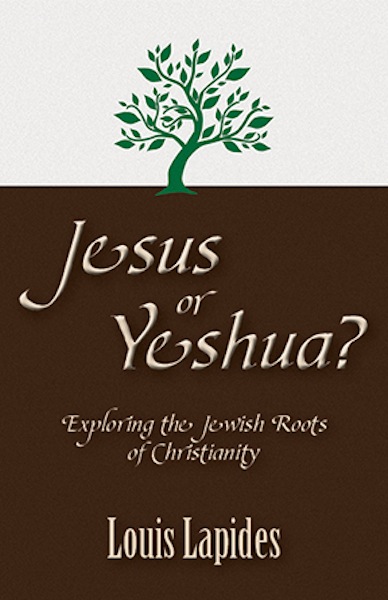
Today ScriptureSolutions published a new booklet written by Louis Lapides. This brief book can be found for Kindle at Amazon.
Jesus or Yeshua: Exploring the Jewish Roots of Christianity by Louis Lapides
It came to no surprise to me that when I first became a Jewish follower of Yeshua, I was going to have a cultural crisis trying to fit into a Gentile Church. I lasted a few months before I started asking inevitable questions, “I’m Jewish. Jesus is Jewish. His first followers were Jewish. The New Testament was written by Jews and a lot of the concepts they discussed have a powerful Hebraic background. Then why is Christianity so “not-Jewish”?
Jesus or Yeshua: Exploring the Jewish Roots of Christianityprovides the reader with some of the findings I came upon as searched for answers to my questions. For me a lot of the issues were resolved when I studied the origin of most of the terminology used by Christians when describing their beliefs and practices. When I was growing up attending Hebrew school in preparation for my Bar Mitzvah I never expected that Rabbi Printz would tell me that the mass practiced by the Catholic Church across the street from our temple was actually based in the Jewish Passover. Nor was I told that baptism has it’s origins in the Jewish practice of immersion or mikveh used when Gentiles would turn from their paganism and convert to Judaism.
Attending a church for me at age 23 was a shocker as I describe in my opening chapter. Here is a sample section from that chapter that will give you an idea of what Jesus or Yeshua: Exploring the Jewish Roots of Christianity is all about.
Here’s a shocker . . . Jewish people don’t feel at ease in a Christian church. The first time I attended a Protestant congregation, a Southern Baptist one, I couldn’t avert my eyes from the 10-foot tall stained glass mosaic of Jesus looming behind the pastor. I imagined for a few moments the man from Galilee was about to step out of the window, float over to my pew and ask whether I noticed the “Jews Not Welcome” sign at the church’s front door. “Of course,” I would respond, “But Jesus, aren’t you . . . .?”
In the last installment of my examination of Rob Bell’s Love Wins, the focus was on the character of God. Bell continues his questioning of the person of God in the remainder of chapter seven, “What is God like?”
Throughout Love Wins Pastor Bell struggles with the idea of a God who is just and punishes sin and a God who demonstrates His love by sending His Son into the world to die for our sins. A quote from a sermon by Pastor Alistair Begg best summarizes the interchange between God’s holy character and love – concepts Rob Bell cannot swallow:
If God in His love . . longs to forgive sinners . . . longs to enjoy friendship with sinners . . and if in His justice He cannot ignore our sins, how then He display His love and execute His justice? The answer lies in the cross of the Lord Jesus Christ. At the cross Jesus is an emblem of the Father’s love and Jesus is the one who bears the Father’s wrath. If He [the Father] were to excuse sin, He would not be true to Himself in the perfection of His holiness. Therefore, sin must be punished. But because of the magnanimous, unbounded nature of His forgiving love, He execute His justice on His Son so that those who deserve that judgment may find in the Son forgiveness, love and eternal life.
The Mars Hill Church pastor feels this kind of statement from Alistair Begg communicates a gospel that “subtly teaches people that Jesus rescues us from God” (pg. 182). Rather Bell offers his Love Wins Gospel as an alternative, “We do not need to be rescued from God. God is the one who rescues us from death, sin and destruction.” It is that Rob Bell ha a foggy notion of the biblical doctrine of salvation. On this point alone Love Wins loses out.
From the Old Testament we learn an innocent animal had to die in exchange for the life of the guilty sinner who offered the animal to find forgiveness of sins. Yes, under the Jewish sacrificial system an innocent goat had to die so the guilty sinner can have his sins atoned for.
In addition, much to Bell’s chagrin,we cannot escape the fact our sin earns God’s wrath as explained in John 3:36, “Whoever believes in the Son has eternal life, but whoever rejects the Son will not see life, for God’s wrath remains on them” and Romans 1:18, “The wrath of God is being revealed from heaven against all the godlessness and wickedness of people, who suppress the truth by their wickedness.”
When Jesus died on the cross, He satisfied the wrath of God against sin. The nature of God is not separate from the “death, sin and destruction” He pronounces against our sin. In fact, the consequences to our sin flow out of the holy character of God and not removed from His character as Bell implies. It is because God is just in dealing with sin that there sin death, sin and destruction. The wrath of God against our sin is due to God’s just character. It is this wrath that Jesus had to deal with on the cross for us to be forgiven. (more…)
Raise your hand if you like the biblical teaching on the existence of hell. My hand is not raised. No, I am not enamored with what the Bible teaches about hell. I take no joy knowing a person I care about may spend eternity in conscious torment, separated from God. I am not sadistic nor do I enjoy seeing people suffer.
In light of my dislike of this biblical teaching, I have two choices. I can accept what the Scriptures teach about hell or I can revise the doctrine until I feel comfortable with it and share my watered-down version with others to make them less comfortable as well.
Welcome to the wild and wacky world of Rob Bell, author of Love Wins. Bell, a competent writer, who has a way with words which he employs to weave a tapestry that makes his hearers feel warm and fuzzy about difficult biblical concepts, but his quilt is filled with broken threads and mismatched patterns.
In chapter 7 called, “The Good News Is Better Than That,” the pastor grapples with the questions, “Why would a compassionate God send good people to hell? Is He really a good God? Isn’t it unfair for a person to spend a brief life span of 70-80 years committing sins and then receiving an eternal punishment that lasts forever?
Bell asks good questions. I don’t like his answers.
Throughout his chapter “The Good News Is Better Than That,” Rob Bell leans strongly towards the view the hell the Bible warns us against is experienced during this life not the the afterlife. The conclusion about hell drawn by the writer of Love Wins, is that hell is our experience of life on earth. (more…)
Dec 6, 2011
Posted by Scripture Solutions on Dec 6, 2011 | Comments Off on Wondering What Happened at the Cross?
The wearing of the cross by celebrities and their imitators as seen in tattoos and jewelry has created too much of a familiarity with the instrument upon which Jesus died. In Pastor Rob Bell’s book Love Wins, his aim in chapter five is to sift through the familiarity of the cross and get to the truth about what took place when Jesus died. With this goal in mind, I am in complete agreement.
As Bell lists the various perspectives on the cross, once again the Love Wins author gravitates to a position of uncertainty. He wants to make the results of Jesus’ death an “either/or” situation. Once again Bell takes a giant leap from traditional Christianity and invents as emergent church godfather Brian McLaren calls, ” a new kind of Christianity.”
The Cross Speaks of the Sacrifice Jesus Made On Our Behalf
First, the author speaks of the death of Jesus by which the Messiah paid for our sins much like the sacrifices in the Old Testament (pg. 123). He quotes from Hebrews 9:26 which claims Jesus appeared “once for all at the end of the ages to put away sin by the sacrifice of Himself.”
Bell compares the sacrifice of Jesus to other cultures where worshippers offered sacrifices to appease the gods or forces in order to maintain a peaceful, favorable relationship with them. How odd! Jesus did not die to put an end to pagan sacrifices or simply to please a whimsical, vengeful. Yet Bell says, “Whole cultures centered around keeping the gods pleased. . . . And now the writer [of Hebrews] is announcing that those days are over because of Jesus dying on the cross” (pp.124-125).
The problem with Bell’s view of the substitutionary death of Christ is that he forgets Jesus was fulfilling and putting an end to the Jewish sacrificial system as described in the Torah books of Leviticus and Numbers. Jesus was not dying to appease the gods of the Greeks or Romans.
The Cross Signifies the Reconciliation Between God and Man
The next meaning of Jesus dying on the cross has to do with reconciliation . In Colossians 1:20 Paul taught, ” and through Him [Jesus] to reconcile all things to Himself, having made peace through the blood of His cross; through Him, I say, whether things on earth or things in heaven”. Reconciliation, according to Bell, has to do with bringing two people together who were estranged and now they found a way to work it out and come back together in a new relationship. (pg. 125).
Here is where you have to watch the craftiness of Pastor Bell. He says on pg. 126 when Jesus died, He made peace “with all things.” You can bet your last dollar Bell will take those words to a place Paul had no intention for the phrase to go. The application of the reconciling work of Jesus to “all things” will be discussed further. (more…)
Nov 28, 2011
Posted by Scripture Solutions on Nov 28, 2011 | Comments Off on Jesus: Here, There and Everywhere
Where were you when you accepted Jesus as your Savior? I was in the Mojave desert under the influence of hallucinogenic drugs crying out for God to deliver me. Regardless of my experience, I refuse to tell others if they want to find Jesus, take several tabs of LSD, Mescaline and Psilocybin and He will appear to them. God forbid!
While I am aware Jesus comes to us in the strangest of places and circumstances, I am hesitant to say things like, “You can find Jesus in Hinduism, Buddhism or any religion that mentions the name of God or gods.” Quite the contrary, each encounter we experience when we find Christ needs consistency and fundamental aspects.
Different Ways People Come to Know Jesus
In Rob Bell’s book Love Wins, a work of exploratory theology, the pastor reports different experiences people had when they found Christ. One person was knocked off his chair and fell prostrate to the ground totally overwhelmed by God’s unconditional love for him (pg. 139). I encountered the same exact sense of God’s love for me in the Mojave desert. Yet as soon as I realized the depth of God’s unconditional grace, I repented of my sin before His holy presence. (more…)
Oct 16, 2011
Posted by Scripture Solutions on Oct 16, 2011 | Comments Off on Mapping Your Way To Heaven-No Room For Error
A most frustrating experience is finding yourself lost in an unfamiliar town and then having to ask strangers for directions to your destination.
Usually, you’ll get one of several responses when you’re dependent on others to get you where you’re headed: the local guy who’s lived in the town all his life but never heard of our destination; the directions a stranger provides confuse us even more; the person that provides directions based on making rights and lefts at fast food landmarks that are located in obscure locations and the person who gives us great directions but his accent is so thick, we have no idea what he’s saying.
In Rob Bell’s highly influential book Love Wins, the author attempts to map out instructions on how to check-in to the Heavenly Hilton in God’s eternal abode. Like many travel websites such as Expedia, Orbitz or Travelocity, the information Bell provides is unclear and leaves us more confused then when we started.
If I was lost and needed to book a room in heaven, I’m not sure Rob Bell’s theology would help me or anyone else.
As I remarked in my last blog, Bell confuses God’s earthly kingdom and His heavenly realm. I call it a “marble cake” theology. He cannot differentiate between the chocolate and vanilla swirl; it’s all blended together and indistinguishable. (more…)