In today’s repost I am including an excellent article written by Rabbi Abraham Cooper, associate dean of the Simon Wiesenthal Center and Rabbi Yitzchok Adlerstein, the Wiesenthal Center’s Director of Interfaith Affairs. Rabbi Cooper and Adlerstein have made some valuable and insightful comments on Gary Burge’s lecture which hegave last month at the Christ at the Checkpoint Conference in Bethlehem last month.
I find it disturbing that it takes two rabbis to take up the clarion call of pointing out Burge’s anti-Jewish bias while the voice of evangelical leaders who claim to be friends of the Jewish people and supporters of Israel remain silent. I am honored to include this article from The Times of Israel on my blog. I encourage you to share this blog with others. If evangelical leaders want to remain passive regarding the current Evangelical Intifada, then let’s take this cause to the wonderful people attending evangelical churches who proudly declare their support for Israel.
Polls in the United States show sustained support for Israel despite relentless campaigns to demonize the Jewish state. Evangelical Christians, who have stood by Israel through thick and thin, are being lobbied by the Palestinians and their allies to drop their support for Zionism and embrace the Palestinian cause.
A presentation by Gary Burge to hundreds of evangelicals who gathered last month in Bethlehem at the Christ at the Checkpoint Conference (CATC) shows that some Palestinian boosters are willing to take us back to the darkest days of Adversus Judaeos.
It was 1970 and I was twenty three. I had just entered Dallas Baptist University as a religion major. I had been following Jesus as my Messiah and Lord for about a year and was anxious to start Bible College and pursue a path to seminary for ministry training. I couldn’t wait to learn more of the Bible and gain a deeper knowledge of God’s dealings with and promises for the people of Israel.
Boy was I surprised! I enrolled in one theology class and an additional seminar in biblical interpretation (aka hermeneutics). As I soon discovered my professors held to a theological system called “amillennialism.” They believed the messianic kingdom promised by the Hebrew prophets to Israel had arrived on earth and was here in its fullest form in the Church. I couldn’t believe my ears.
I raised my hand in my hermeneutics class, “Professor, have you been to downtown Dallas lately? The last time I was there I observed strip clubs and several ‘ladies of the night’ out on the streets selling their talents. And not only that, according to the Dallas Morning News, there are a rash of homicides in Dallas. Isn’t it also true that this is the city in which President John F. Kennedy was assassinated? I am not buying your teaching that the kingdom of God is here on earth right now especially in Dallas. Furthermore, several churches in downtown Dallas are still practicing racial segregation. Where is the kingdom of God? Certainly not in the church and not here in Big ‘D’!”
My professor was shocked by my outspokenness. Perhaps he’s never met a Jewish person who was courageous enough to challenge his beliefs.
The professor continued to argue the kingdom of God is realized in its fullest in the church. I couldn’t keep my mouth shut, “Do you mean to tell me that churches where racial segregation is still practiced here in Texas and where antisemitism still exists is a manifestation of God’s promised kingdom? According to Revelation 20:2 the devil is supposed to be thrown into a pit and bound for a thousand years with the result that justice and righteousness will rule the earth under the rule of the Messiah. Either the thousand years are up and Satan is on the loose or he’s a Houdini and escaped his shackles. I still don’t get it. Maybe the kingdom of God is here, but God forgot to include Dallas.”
I was getting upset. These Christians were living in a dream world if they thought we were living in the kingdom of God on earth as described in the fourth chapter of prophet Micah:
In the last days the mountain of the LORD’s temple will be established as the highest of the mountains; it will be exalted above the hills, and peoples will stream to it. Many nations will come and say, “Come, let us go up to the mountain of the LORD, to the temple of the God of Jacob. He will teach us his ways, so that we may walk in his paths.” The law will go out from Zion, the word of the LORD from Jerusalem. He will judge between many peoples and will settle disputes for strong nations far and wide. They will beat their swords into plowshares and their spears into pruning hooks. Nation will not take up sword against nation, nor will they train for war anymore. Everyone will sit under their own vine and under their own fig tree, and no one will make them afraid, for the LORD Almighty has spoken.
I boldly declared, “If we are in the kingdom of God right now, then where are the promised fulfilled to Israel? Only three years ago the Six Day War was fought in the holy land, and Israel is still surrounded by her enemies. Where are God’s promises to the Jewish people to have the Messiah ruling His kingdom from a throne in Jerusalem? Professor, you are ignoring the prophetic message that Isaiah, Ezekiel and Daniel and all the Hebrew prophets uttered to the Jewish people throughout the centuries.”
With even more boldness [or chutzpah) my Bible teacher said, “The church is Israel, Louis. Christians are the true seed of Abraham. The church has replaced Israel as God’s chosen people. God is finished with Israel as a nation and only works with them on an individual basis regarding personal salvation. He will offer Israel a chance to accept Jesus when He returns. The Lord does not deal with Israel as a nation anymore. We as Christians are the true Jews. We are spiritual Jews.”
I was ready to plotz. I was not about to let my professor’s last statement go unanswered, “You’re telling me you’re Jewish. You’re about as Jewish as a ham sandwich on Wonder bread with mayonnaise. With all due respect professor, but you’re making God out to be a liar. He promised Abraham in Genesis 12:1-3 to make him a great nation, to give him the land of Israel and to bless the world through him as the father of many nations as described in Micah 4:1-4. Now you’re telling me Jews are no longer Jews, but Christians are the true Jews. God lied to Abraham and everyone else in the Bible. The word church or ekklesia is not even in the Jewish Bible. Is this what Christianity teaches . . . that God pulled off a bait-and-switch regarding His promises to Israel? (more…)
At the recent Christ at the Checkpoint conference in Bethlehem, an array of pro-Palestinian Christian speakers shared their thoughts on the current status of the Palestinian Christian Church, their opposing views to Christian Zionism and their own theological stance commonly known as replacement theology. Munther Isaac, Instructor, Vice Academic Dean and Choir director at Bethlehem Bible College, delivered a message entitled, ” A Palestinian Christian Perspective” in which he referred to himself both as a person of Arab descent and since he is a follower of Jesus, claimed to be one of the “seed of Abraham.” Then in his message he took a theological leap to refer to himself as part of Israel, the true spiritual Israel.
The belief that Christians are members of the seed of Abraham is nothing new in Christendom. While several verses are found in the New Testament referring to followers of Jesus as the “seed of Abraham,” most evangelicals commit a theological error by referring to themselves as the “true Israel.”
It is my contention no verses exist in the New Testament can be found where Paul or any other New Testament writer refers to Gentiles as anything other as “gentiles.” Listen to Paul in Romans 1:5: Through him we received grace and apostleship to call all the Gentiles to the obedience that comes fro faith for his name’s sake. Then again in Romans 11:11: 11 “Again I ask: Did they stumble so as to fall beyond recovery? Not at all! Rather, because of their transgression, salvation has come to the Gentiles to make Israel envious.
In Romans 11:11 Paul makes a distinction between Gentiles who follow Jesus from Jewish people or members of the nation of Israel. In Romans 11:13 Paul speaks to gentile converts to Christ and refers to them as “gentiles” and not spiritual Jews or members of spiritual Israel: I am talking to you Gentiles. Inasmuch as I am the apostle to the Gentiles, I take pride in my ministry.
Once again Paul distinguishes Gentile followers from the Jewish people in Romans 15:27: They were pleased to do it, and indeed they owe it to them. For if the Gentiles have shared in the Jews’ spiritual blessings, they owe it to the Jews to share with them their material blessings. (more…)
Mar 27, 2012
Posted by Scripture Solutions on Mar 27, 2012 | Comments Off on Israelis At the Knifepoint
In a recent short video filmed by Producer Porter Speakman Jr. he posted a film for the Christ at the Checkpoint Conference 2012 website. According to the CATC2012 website this piece “The Checkpoint” looks at “the system of Israeli checkpoints in the West Banks and the daily routine Palestinians must face going through the Bethlehem Checkpoint.” Here is the film for your viewing.
Rich Stearns, president of Christian relief organization World Vision had spent a memorable meal with Palestinian Christians and 30 American pastors and church leaders in a cave west of Bethlehem. After the half mile hike to reach his destination at the top of a hillside, he was greeted by a sign that read, “We refuse to be enemies.”
The West Bank section of land where this Christian gathering took place is a mere 100 acres. However, its Palestinian residents, the Nassars have turned their property into an touch point for demonstrating to evangelical American Christians how unfairly Palestinian Christians are being treated by Israelis.
Here is a video made three weeks ago by Porter Speakman Jr, director of pro-Palestinian Christian film With God on Our Sideabout Nassar family. This video was recently aired at the Christ at the Checkpoint Conference at Bethlehem Bible College in Bethlehem.
The Nassars claim they have owned the land since 1916, and according to international law, the territory does not belong to Israel, but to the Nassar family. Currently, according to World Vision President Stearns, the parcel of land is surrounded by 50,000 Israeli settlers, “living on similar land confiscated from other Palestinian families.”
Today’s blog is a reposting of an article I wrote in 2008 regarding the alleged ossuary of Jesus as purported by famous director/producer James Cameron (Terminator, Avatar and Titanic). Since the bone box of James, the brother of Jesus as not been proven to be a fake by the Israeli Antiquities Authority, it is of no surprise that the creators of the Lost Tomb of Jesus Discovery Channel documentary would attempt to bring back the Jesus Family Tomb controversy. Here is a reposting of my blog composed four years ago.
In Spring ’07 the Discovery Channel aired a TV documentary, The Lost Tomb of Jesus, made by Hollywood director James Cameron and Canadian investigative journalist Simcha Jacobovici.
According to an article in Time magazine, the documentary “re-examines an archaeological find from 1980 in which a crypt [the Talpiot tomb] was found containing what were said to be the ossuaries of Joseph, Mary, Jesus, the son of Joseph, Mariamne (possibly Mary Magdalene, say the film-makers) and Judah, son of Jesus.”
The controversy of whether or not the Talpiot tomb once contained the remains of Jesus and His family stayed on the media circuit for a few months in Spring ’07 prior to the airing of the documentary and for a few weeks afterwards. Soon after several TV appearances by the filmmakers and a flurry of Christian articles refuting the claims of The Lost Tomb of Jesus, the controversy fizzled.
In 2008 according to Time magazine the controversy was opened once again. “Still, even after the furor over the film faded, the questions it raised about the tomb unearthed in 1980 continued to make waves among archaeologists and Biblical scholars,” says the Time magazine piece.
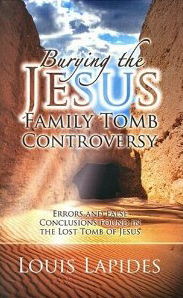
Little did I know that when I wrote a 30 page booklet entitled Burying the Jesus Family Tomb Controversy that The Lost Tomb of Jesus would make a re-appearance. At the time I composed the booklet, I felt the issues raised by Cameron and Jacobovici were so important that the errors and false conclusions made in the documentary had to be addressed. In fact, the Time magazine article admits the “debate over Jesus’ supposed tomb will probably rage for years to come.” (more…)
Mar 19, 2012
Posted by Scripture Solutions on Mar 19, 2012 | Comments Off on The Burial Box of Jesus’ Brother James – Fact or Fake?
After seven years of trial, testimonies from a lineup of archaeological experts and a 475 page verdict, presiding Judge Aharon Farkash of the Jerusalem District Court court not reach a decision supporting the fact the ossuary [a limestone burial box] of James, brother of Jesus, was a forgery. As a result the Jerusalem judge could not charge Israeli collector Oded Golan, the owner of the bones box of James, with forgery regarding the ossuary.
A Huffpost Religion article summed up the seven year controversy and what the final verdict implies:
Golan said the ruling put an end to what he portrayed as a 10-year smear campaign against him. Hershel Shanks, editor of the Washington-based Biblical Archaeology Review, said he was delighted, insisting the burial box, or ossuary, is authentic and a “prized artifact to the world of Christianity.”
The Israel Antiquities Authority, which believes Golan’s most high-profile items are forged, said the case shows the limits of science in proving forgeries, but it also prompted museums and universities around the world to be more suspicious of finds of uncertain origin.
In light of the ruling students of the Bible are left with the conclusion the ossuary may be authentic after all and that science could not debunk the veracity of the claim that the box once housed the bones of James, the brother of Jesus of Nazareth.
In the last installment of my examination of Rob Bell’s Love Wins, the focus was on the character of God. Bell continues his questioning of the person of God in the remainder of chapter seven, “What is God like?”
Throughout Love Wins Pastor Bell struggles with the idea of a God who is just and punishes sin and a God who demonstrates His love by sending His Son into the world to die for our sins. A quote from a sermon by Pastor Alistair Begg best summarizes the interchange between God’s holy character and love – concepts Rob Bell cannot swallow:
If God in His love . . longs to forgive sinners . . . longs to enjoy friendship with sinners . . and if in His justice He cannot ignore our sins, how then He display His love and execute His justice? The answer lies in the cross of the Lord Jesus Christ. At the cross Jesus is an emblem of the Father’s love and Jesus is the one who bears the Father’s wrath. If He [the Father] were to excuse sin, He would not be true to Himself in the perfection of His holiness. Therefore, sin must be punished. But because of the magnanimous, unbounded nature of His forgiving love, He execute His justice on His Son so that those who deserve that judgment may find in the Son forgiveness, love and eternal life.
The Mars Hill Church pastor feels this kind of statement from Alistair Begg communicates a gospel that “subtly teaches people that Jesus rescues us from God” (pg. 182). Rather Bell offers his Love Wins Gospel as an alternative, “We do not need to be rescued from God. God is the one who rescues us from death, sin and destruction.” It is that Rob Bell ha a foggy notion of the biblical doctrine of salvation. On this point alone Love Wins loses out.
From the Old Testament we learn an innocent animal had to die in exchange for the life of the guilty sinner who offered the animal to find forgiveness of sins. Yes, under the Jewish sacrificial system an innocent goat had to die so the guilty sinner can have his sins atoned for.
In addition, much to Bell’s chagrin,we cannot escape the fact our sin earns God’s wrath as explained in John 3:36, “Whoever believes in the Son has eternal life, but whoever rejects the Son will not see life, for God’s wrath remains on them” and Romans 1:18, “The wrath of God is being revealed from heaven against all the godlessness and wickedness of people, who suppress the truth by their wickedness.”
When Jesus died on the cross, He satisfied the wrath of God against sin. The nature of God is not separate from the “death, sin and destruction” He pronounces against our sin. In fact, the consequences to our sin flow out of the holy character of God and not removed from His character as Bell implies. It is because God is just in dealing with sin that there sin death, sin and destruction. The wrath of God against our sin is due to God’s just character. It is this wrath that Jesus had to deal with on the cross for us to be forgiven. (more…)
Mar 9, 2012
Posted by Scripture Solutions on Mar 9, 2012 | Comments Off on Does the Christian View of God Need Revising?
As kids we compared one another’s fathers to prove “my Dad is better than your Dad”. When my son Justin was attending kindergarten, he informed me about a kid in his class who boasted his father played baseball for the Los Angeles Dodgers. Since I am a baseball fanatic, I had to check it out.
After spending an hour investigating the Dodger website, I concluded Justin’s friend was lying. In fact, the kid’s father did not even work in the Dodger front office as a business executive let alone as a baseball player. I told my son his friend is making up stories about his Dad. I then proceeded to tell my kindergartner that I used to play first base for the New York Yankees!
Speaking of dads, in chapter seven of Rob Bell’s controversial book Love Wins, the Pastor compares our earthly fathers to God the Father.
The Theology of a Bi-Polar God
In light of Bell’s comparison, the pastor of Mars Hill Church in Grandville, Michigan comes up with the reason why people do not accept Jesus. Bell wonders, “If your God is loving one second and cruel the next, if your God will punish people for all of eternity for sins committed in a few short years . . . no amount of clever marketing . . . will be able to disguise that one, true, glaring, untenable, unacceptable, awful reality” (page 175). In light of this statement the author sums up what his view of hell is: hell is refusing to trust and refusing to trust is often rooted in a distorted view of God (pg. 175).
If we had a human father who like the God of Christianity was loving one second and then cruel the next, we would tag him an “abusive father.”
Therefore, the God portrayed by followers of Jesus is both loving and cruel. Therefore, how can Christians expect anyone to accept the Christian message of a cruel, abusive God the Father after also being told God so loved that world that He sent His Son to die on a cross to save people from eternal torment? (more…)
Raise your hand if you like the biblical teaching on the existence of hell. My hand is not raised. No, I am not enamored with what the Bible teaches about hell. I take no joy knowing a person I care about may spend eternity in conscious torment, separated from God. I am not sadistic nor do I enjoy seeing people suffer.
In light of my dislike of this biblical teaching, I have two choices. I can accept what the Scriptures teach about hell or I can revise the doctrine until I feel comfortable with it and share my watered-down version with others to make them less comfortable as well.
Welcome to the wild and wacky world of Rob Bell, author of Love Wins. Bell, a competent writer, who has a way with words which he employs to weave a tapestry that makes his hearers feel warm and fuzzy about difficult biblical concepts, but his quilt is filled with broken threads and mismatched patterns.
In chapter 7 called, “The Good News Is Better Than That,” the pastor grapples with the questions, “Why would a compassionate God send good people to hell? Is He really a good God? Isn’t it unfair for a person to spend a brief life span of 70-80 years committing sins and then receiving an eternal punishment that lasts forever?
Bell asks good questions. I don’t like his answers.
Throughout his chapter “The Good News Is Better Than That,” Rob Bell leans strongly towards the view the hell the Bible warns us against is experienced during this life not the the afterlife. The conclusion about hell drawn by the writer of Love Wins, is that hell is our experience of life on earth. (more…)