Herman Munster. CBS Television, Public domain, via Wikimedia Commons.
As an undergraduate majoring in religious studies, I was expected to take a semester-long course entitled “hermeneutics.” I had no idea what this term meant. As a young boy, the only religious subjects I ever heard about were in Hebrew school. Unsurprisingly, my synagogue in Newark, NJ, did not offer a course in “hermeneutics.”
The only connection I made to any person named “Herman” was TV’s parody of the Frankenstein monster known as Herman Munster. Maybe the university I attended expected me to take a class on British rock bands, focusing on the British pop group “Herman’s Hermits.” I wasn’t sure lead singer Peter Noone had enough hits to fill a semester’s coursework
I soon discovered other famous Hermans, including the TV character Pee Wee Herman and the NY Yankee baseball great George Herman “Babe” Ruth. Eventually, I wised up and realized the Religious Department of Dallas Baptist University would hardly offer a semester course that catered to my penchant for nostalgia.
So what is hermeneutics? After further investigation, I learned that hermeneutics is a discipline necessary to correctly understand the Scriptures, both the Hebrew text and the New Covenant. I hope I cleared up this mystery for those struggling to understand what “hermeneutics” is all about. Perhaps you feel Pee Wee Herman is more interesting.
The Centrality of Biblical Hermeneutics
I like the definition of hermeneutics offered by the IVP Pocket Dictionary of Τheological Terms (pg. 59, InterVarsity Press, 1999):
The discipline that studies the principles and theories of how texts ought to be interpreted, particularly sacred texts such as the Scriptures. Hermeneutics also concerns itself with understanding the unique roles and relationships between the author, the text, and the original or subsequent readers.
When a student applies hermeneutical skills to the sacred text of the Tenach or the New Testament, they understand the passage(s) being studied with greater respect. Hermeneutical proficiency prevents the Bible student from making superficial observations about a biblical passage. Instead, the student is called to study a passage seriously, in a way that conforms to the author’s original intent.
Are you ready for this? Without understanding hermeneutics, the student of religion cannot begin to comprehend what many Bible verses are about.
Dare I say it? A good grasp of biblical hermeneutics is the central tool for making sense of many hard-to-decipher Scripture passages.
I hope I raised your curiosity. So let’s take a break from listening to our worn-out Herman Hermit’s 45s and take a deep dive into hermeneutical tools.
In the last post, I compared running a race in which a runner hands off a baton to another runner to how many evangelicals view an alleged handoff between the Jewish Scriptures and the New Covenant.
In foot racing, a technique called the handoff, or baton pass, is used. One runner passes a strike (baton) to the next runner. The goal is to keep running without dropping the baton. Once the baton is handed over, the former carrier drops out of the contest and allows the handoffee to keep running.
This is how most Christians view the relationship between the two testaments. The baton is the redemption story that runs through both volumes. The Old Testament, or the first runner, hands off the redemption thread to the New Testament (second runner). Next, the Old Testament drops out of the race. Evangelicals will often say the Tenach has done its job and there is no longer a need for the Hebrew Scriptures.
Are these evangelicals correct? Did the Jewish Scriptures hand off the redemption story to the New Covenant and then drop out of the race? Does the Hebrew Bible still speak to us today, or has the ancient text completed its job?
As far as I can tell, the runner attached to the Jewish Scriptures is still part of the race and continues to speak to us today.
I propose that BOTH TESTAMENTS grasp the baton of the redemption story and run the race together, hand in hand. Despite what Christian theologians and pastoral figures teach, NT writers do not view the Tenach as outdated, discarded, or unnecessary.
I’ll address these issues in great depth in this post and the next. In the meantime, I want to clarify my terminology. The reader will note that I refrain from any overuse of the term “Old Testament.” The word OLD makes the Hebrew text appear outdated or even inferior to the NEW Testament.
Therefore, I prefer terms like Jewish Bible or Scriptures, Hebrew Text, or the Tenach. Tanakh is an acronym using the Hebrew letters that describe the three-part breakdown of the Hebrew text: Torah, Nevi’im (the prophets), and the Ketubim (the writings). The first letters of these three terms are as follows: TNK, or TeNaK, also spelled Tenach. When I do use the term “Old Testament” in this post, it is mostly for stylistic reasons.
Last year I was briefed by the MLB. TV app that I had watched or listened to over 130 hours of baseball in 2025. I wasn’t surprised. Major League Baseball is a sport that plays well without having to view the game on TV; one can also savor the radio feed. Yet, the listening quality of a baseball game depends on the expertise and sensitivity of the sports broadcaster.
As an NY Yankees fan, I took pleasure in the years I spent listening to the radio voices of John Sterling and Susan Waldman call the Bronx Bombers’ baseball games. Since I now live in Southern California, I also relished the broadcasting skills of LA Dodgers legendary announcer Vin Scully.
One of the skills of a crack baseball commentator is knowing when to stop talking and let the game breathe! Scully was a master at detecting the intensity of a game when the Dodgers were in a win-or-lose situation.
It’s the bottom of the ninth. The Blue Crew are down by one run with two outs and two eager runners on second and third. The opposing pitcher has a full count on the batter. The crowd is edgy, but silent.
What in the world would Scully say? Share a few recent stats on the perspiring pitcher’s record with men on base in the bottom half of the ninth inning? How about several fresh analytics on how the LA hitter performs in these situations?
Nope! Scully would remain silent.
Vin waited on the inhale of bated breath of the LA crowd, and the exhale of the next pitch, to call the game any further. His baseball broadcasting was priceless.
For expert broadcasters of America’s National pastime, a crowd’s intense silence at the bottom of the ninth needs no additional baseball banter. Instead, the hushed anticipation of baseball fans poised to see their team take the lead speaks louder than any barrage of statistics, analytics, and speculation. It is prime time to let the game breathe.
When the Hebrew Scriptures Need to Breathe
The same observation applies to how some pastors interact with the Jewish Scriptures, which Christians refer to as the Old Testament.
At times I perceive evangelical pulpiteers unnecessarily throttle the Hebrew Scriptures by carpeting the ancient text with Christian themes and far-fetched applications. These biblical orators feel the need to insert Christian theology into a text directed at ancient Israel and sidestep the message God originally steered towards the Jewish nation.
When this scenario occurs, the original application of a passage is lost. In other words, the pastor refuses to allow the Jewish Scriptures to breathe on their own. Instead, he flings an NT blanket to smother the words of the Hebrew text lest his non-Jewish Christian audience be confused by a passage that contains a present-day or future message to the Jewish people.
Growing up in New Jersey as a seven-year-old was an East Coast dream. Swimming at the sunlit Jersey shore. Fishing in northern Jersey lakes. Strolling through New York’s Times Square. I was a dyed-in-the-wool Jersey boy.
No New Jersey summer was complete without the family visit to Atlantic City’s Steel Pier. Of course, I spent the day dogging my parents about when we would attend Steel Pier’s diving horses extravaganza.
Who wouldn’t be thrilled to watch a woman on horseback plummet 40 feet into a water tank?
The Roy Rogers Rodeo was another contender for my attention. At this Western round-up in New York’s Madison Square Garden, I fantasized I would become the first Jewish buckaroo.
Unfortunately, my parents were adamant that horseback lessons should take a rear saddle to my Bar Mitzvah preparations.
Every winter, my Mom and Dad would ferry my brother and me through the Lincoln Tunnel to attend the Barnum and Bailey Circus at MSG. I always looked forward to the clown acts, but loved the daredevil horseback stunts most.
My favorite horseback riding trick is known as Roman riding. A performer stands or balances on the backs of two horses driven abreast, taking hurdles or performing other stunts.
I was always convinced these dazzling skills only belonged in the three rings or a riding arena. Yet I was recently briefed that Jesus may have performed a daredevil balancing act when He paraded into Jerusalem on what some believe was two donkeys.
Messiah’s Unusual Entrance into Jerusalem
I recently encountered this dilemma surrounding Yeshua’s Triumphal Entry while teaching a seminar on the messianic prophecies in the Gospel of Matthew. I was expounding on Yeshua’s entrance into Jerusalem in fulfillment of the messianic passage in Zechariah 9:9, which reads:
“Rejoice greatly, O daughter of Zion! Shout aloud, O daughter of Jerusalem! Behold, your king is coming to you; righteous and having salvation is he, humble and mounted on a donkey, on a colt, the foal of a donkey “ (Zechariah 9:9 ESV).
In Matthew 21:5-7, the gospel writer quotes from the Minor Prophet Zechariah to show how Yeshua’s jaunt into the holy city fulfills this prophecy:
“Say to Daughter Zion, ‘See, your king comes to you, gentle and riding on a donkey, and on a colt, the foal of a donkey.’ ” The disciples went and did as Jesus had instructed them. They brought the donkey and the colt and placed their cloaks on them for Jesus to sit on” (Matthew 21:5-7 NIV11).
In the NIV and the KJV’s translation of Zechariah 9:9, the Messianic King rides into the holy city on two donkeys. In stark contrast, in most English translations of Zechariah 9:9, the Messiah journeys into a rejoicing Jerusalem on one donkey.
Unsurprisingly, a class member raised her hand to inquire about this quizzical discrepancy in the Matthew text. The student wondered, “Why does Matthew record two donkeys, a mother and a young colt? Didn’t Zechariah prophecy that the Messiah would ride on ONE donkey?
The student questioned further, “Matthew also recorded that Jesus sat on THEM. Did Yeshua sit on BOTH the mother donkey and her colt simultaneously?”
The picture this Bible student was portraying turns Yeshua’s entry into Jerusalem into quite a spectacle. Did He ride on the donkeys both at the exact moment or one at a time? I did not have an immediate response.
I knew my understanding of this passage required more research
I also encountered another quandry about the Triumphant Entry. Was Yeshua’s entry into Jerusalem actually “triumphant”?
Pastors often claim Jesus journeyed into Jerusalem to claim Himself as the long-awaited King of Israel. Initially, the Jewish crowds accepted Jesus’ victorious entry four days before Passover. But later in the week, the “same” crowds cried for Yeshua’s crucifixion.
Was Yeshua’s journey into the city of David a victorious military event? Did the crowd misunderstand Yeshua’s message in His memorable entry before His crucifixion?
I decided to do a deep dive into the messianic prophecy of Zechariah 9:9. Then, I would spring over to Matthew 21 to further investigate this possible biblical juggernaut. The results of my private investigation are found in this article.
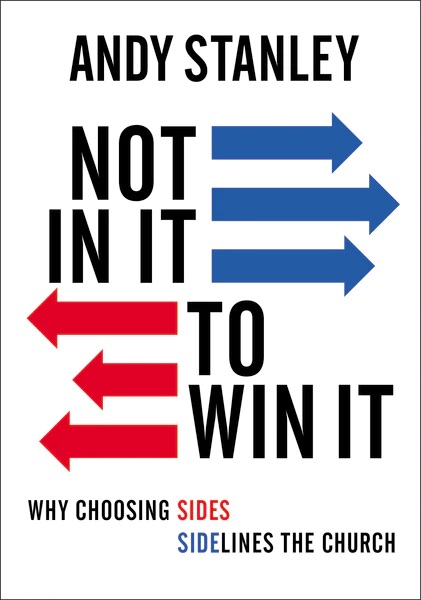
It’s about time! Some evangelical superstar had to say something. We can no longer ignore the gorilla of extreme conservative politics running berserk in today’s evangelical Church. In Pastor Andy Stanley’s book, “Not In It To Win It,” the author boldly goes where most evangelical leaders fear to tread.
The pastor of North Point Church in Alpharetta, GA is exasperated over the current trend of evangelicals who align themselves with right-wing conservative elements. He raises eyebrows in his criticism of pastors, Christian podcasters, and leaders who “lined up behind their political party of choice and leveraged our sacred text to validate political talking points.”
Most importantly, Pastor Stanley recognizes this development is detrimental to the cause of bringing the good news of redemption to all people.
In past generations, Christians broke down our culture into those who know Jesus and those who don’t. Instead, a significant segment of evangelicals has divided our society politically into the Left and the Right.
A few months back, I was amazed listening to a message by modern-day “prophet” and evangelist Mario Murillo in which he stated the “enemy of the Christian is the Democrats.” Even Jesus did not designate the Romans or the Sadducees as enemies of His followers. Yeshua viewed His day’s political and religious parties as lost sheep in need of salvation, not ideological adversaries.
Evangelicals have turned a new corner where Jesus’ followers are intent on changing our world through endorsing political efforts, passing laws that reflect conservative principles, and supporting Right-wing candidates regardless of their ties to white Christian nationalism. Stanley points out that Jesus no longer changes lives in this revised evangelical era. Instead, Right-wing political activism is the key to the transformation of our broken society.
The past five years have been extremely challenging since I am not 100% on board with the angry tenor of evangelical conservative politics. I’ve witnessed ridicule and rejection from fellow evangelicals on social media because of my convictions.
Brotherhood in the Lord has been trumped by something or someone else. I sense my spiritual connection to certain Christians is no longer enough.
Nevertheless, I consider myself an independent who embraces the core tenets of conservatism.
We are not here to “win” elections, argues Stanley, but for a greater purpose: to radiate the love and compassion of Yeshua to bring non-believers to His redeeming power.
The key takeaway points I gained from “Not In It To Win It” (NIITWI), in addition to my observations, are as follows:
*Evangelicals have shifted the focus from sharing the good news to supporting political causes
*Evangelicals have opted to cancel fellow Christians who do not align with their conservative political viewpoint
*Evangelicals are placing their trust in political activism to change America’s culture more than the power of the Messiah Jesus
*Evangelicals have little issue aligning themselves with Right-wing politicians and talk show media stars who have the reputation of being white nationalist and even antisemitic
*Evangelicals have revised the Christian message as one bent on saving America rather than Americans.
*Evangelicals have no biblical basis for espousing the idea God made a covenant with America.
In Matthew 3:2 the prophet John the Baptizer in the New Covenant admonished his fellow Jewish seekers, “Repent, for the kingdom of heaven is at hand.” Today many evangelicals have revised John’s call to prepare oneself for the coming of God’s kingdom on earth. Today Matthew 3:2 has been revised to say, “Vote, for the kingdom of God is at hand.”
Residents of Afghanistan are fleeing their war-torn country to escape a repressive Taliban rule. A recent earthquake decimated the population of Haiti. Unexpected forms of Covid-19 threaten to infect more Americans. Residents of US cities are at one another’s throats over issues like masks and vaccinations used to prevent the spread of Covid. Even churches divide over being compliant with government orders to close their doors to curtail potential virus contamination. Climate control remains a hot topic for those who believe our environment is crumbling due to human indifference and mismanagement of our resources.
No wonder people inquire whether we are teetering on the brink of Earth’s final days. Recently, someone asked me if we are experiencing the last of the birth pangs Yeshua mentioned as portents of His return (Matthew 24:7-8). Is this the end? Can we look at current events as guaranteed signs of the final moments of the last days?
In 2006, I delivered a message on the questions Christians raise when we face troubling situations. Surprisingly, the list of disturbing signs of the last days was not too different 15 years ago. Devastating earthquakes. Powerful hurricanes. The predicted economic collapse of the stock market. Ongoing, persistent poverty. Increasing wars and terrorism. Political upheaval. Lack of trust in our news sources. False teaching among evangelicals. The moral corruption of our trusted leaders. Continual skirmishes in Israel. Not much has changed.
Again, I raise the questions on everyone’s mind, “Are the events mentioned above indicators of the final days? Are we in alignment with the Scriptures, or are we interpreting the Word of God the way we want out of sheer panic?
I felt it would be timely to revisit this message and apply its relevance to 2021 as we rush towards the dawning of 2022.
Israel as the Centerpiece in the End Times
In his book, The Will to Live On, Herman Wouk tells the story of a meeting he had with Israel’s first president David Ben-Gurion. Wouk writes in his book, “My wife Sarah and I visited Ben-Gurion’s house in the Negev desert. And the next day we traveled to Sde Boker or “the fields of mourning” kibbutz, in a command car escorted by a jeep with a mounted machine gun.” Wouk writes, “For back in 1955 when this took place, this little country was being harassed by terrorists from Egypt and Gaza.”
“When we were leaving, Ben-Gurion came out with his straight Zionist line. “You must return here to live. This is the only place for Jews like you. Here you will be free.”
And Herman Wouk said, “Free? Free with enemy armies with their leaders threatening to wipe out the Zionist entity? Free?”
And Ben-Gurion said, “I did not say ‘safe,’ I said ‘free.'”
In the light of recent rocket attacks on Israel (2006) launched by the terrorist group Hezbollah and hundreds of thousands of Muslims protesting against Israel in the streets of Baghdad, in Tehran and Libya, the Jewish nation is not in a safe situation.
America’s support for Israel is bringing our country deeper into the crosshairs of Islamic terrorists.
In 2006 Yemenite president Ali Abdullah Saleh said, “I hope all countries bordering Israel will join the war. Arab countries should allow the transfer of weapons and people to Lebanon and Palestine. Every Muslim has the individual duty to fight on this front.”
Here is another disturbing quote that exposes radical Islam’s hatred of Israel, spoken 15 years ago by Iran’s supreme leader Ali Khamenei, “Everyone realizes the attack on Lebanon was a Zionist-American operation. It is the first step towards taking control over the Middle East and over the entire Muslim world. Bush and his American partners will be considered just as responsible and accountable for these events as the evil and depraved leaders of the Zionist regime.”
On the positive side, the Los Angeles Times took a poll on August 2, 2006. According to the census, most Americans—59%–consider Israel’s bombing campaign in Lebanon in self-defense justified. Albeit, Americans are divided about how closely we should align ourselves with the Jewish state. The time will come when we will have no other choice but to get involved. And the question is: Will America stand by Israel, not if, but when the whole world turns against Israel?
After reading multiple blogs on ScriptureSolutions, the user is made aware of how important Israel is in understanding the timeline of the last days. Bible students who omit Israel as a primary focus before the return of Yeshua will experience frustration trying to stitch together the events of prophetic history.
Fifteen years ago, I studied the tower of Babel to gain insight into humanity’s aversion to God and His decision to make Israel His elect nation. It may come as a surprise to realize the events at the ancient tower of Babel connect to the biblical timeline of Israel’s history leading into the modern era.
The World’s Relationship with God in the End Times
Is the world safe anymore? Where is all this conflict heading? What’s the bigger picture?
Genesis chapter 11 is the story of the tower of Babel. This account provides us with a picture of a world bigger than Israel and the United States. At the tower of Babel, a spiritual energy emerged that changed the course of history. After the Flood of Noah, the remainder of the human race gathered together at the famed Tower of Babel. This remnant of humanity conglomerated in one place in defiance and arrogance against the Creator God.
The modern person must know this same spirit, according to prophecy, will be unleashed again in the last days. As the world once attempted to evict God from His Creation symbolically at the tower of Babel, we will try again at the end of time.
Yes, Israel is crucial to interpreting end times prophecy. Israel is the centerpiece of the prophetic stage before the return of Israel’s Messiah. With Israel, God’s focus is primarily national. However, His intention has always been to bless the global community through Israel. Yet, before the coming of the awaited Redeemer, the international scene will take once more turn for the worst as we see at Babel.
Of course, how the world either draws close to God or shuns Him will affect how the nations treat Israel. Before God blesses the planet Earth through Israel, the world community must first acknowledge the God of Israel. Sadly, this realization will become a lost commodity at the end times. The farther society runs from God and renounces Israel, the more unsafe the world becomes.
Any environment becomes unsafe when humanity wants nothing to do with the Creator. Signs exist today that the same spirit of detachment from God witnessed at the Tower of Babel makes its presence known once again.
What are the signs of a world where safety in God is missing?
A study from the Reuters Institute for the Study of Journalism asked thousands of people what news was most important to them. International news beat out celebrity and “fun” news by a margin of two-to-one. Economic and political news finished even higher. But what happens when readers were asked not what’s important, but what they actually read?
Derek Thompson with The Atlantic claims most Americans lie about what they actually read. He explains: [On June 17, 2014], the most important story in the world, according to every major American newspaper this morning, is the violent splintering of Iraq.
So what did we actually read on June 17, 2014? The top stories across the big media outlets focused on the World Cup, a YouTube game, gluten and postpartum depression, the Miss America Pageant, and the Video Music Awards. Thompson concludes, “Ask audiences what they want, and they’ll tell you vegetables. Watch them quietly, and they’ll mostly eat candy.”
If we are truthful about ourselves, we discover we are rather dishonest. Consequently, we wouldn’t par too well if we were asked to submit to a spiritual fitness test based on a thorough self-examination of our inner truthfulness. We tend to overestimate our goodness and underestimate how much we need to repent and grow.
In Proverbs 16:2 Solomon beckons us to sign up for an investigation of our inner lives lest we be scammed by a dishonest heart. (more…)
Sep 9, 2016
Posted by Scripture Solutions on Sep 9, 2016 | Comments Off on Planning for the Future With or Without God
One of today’s most popular sports cheers was first chanted in 1999 during the fourth quarter of an Army-Navy football game. The six-word cheer—I believe that we will win!—has been called the “epitome of classic American optimism.” Yet in real life, this overly confident attitude tends to backfire.
For instance, a 2002 study found overly optimistic grad students have a tougher time finding jobs. Students in their last year of grad school were asked to rate how likely they thought they were to land a good job shortly after leaving school.
Two years later, those who had admitted to frequent positive fantasies about life after grad school were less likely to succeed in their job search. The daydreamers sent out fewer résumés, and earned less than students who had a more realistic take on their post-university lives.
Positive thinking has its place, but we can mistake daydreaming about achieving our objectives for actually attaining those goals. To make things worse Christians will pull God into our daydreams and assume He’s dreaming the same dreams right along with us.
In Proverbs 16:1 Solomon helps us examine the way we reach decisions for the future. However, the usual interpretation of this proverb is “the Lord will show us what to do and what direction to take without much human effort.” Why think or plan if God has already done the designing for us?
Christians who fail to grasp the teachings of Solomon in this proverb can spend their lives walking in circles. This is not because they “missed God’s will”, but as the result of failing to follow the directions found in Proverbs 16:1 on how to properly plan for the future.
Having lunch at Subway is an unusual experience. I am in awe of how much time it takes to order a sandwich. My sandwiches are the same: meat, lettuce, tomatoes and mustard . . . . wrap it up.
Hungry people study the choices before them behind the glass case like they are on an archeological dig. We’ll take all the time we need to pick out exactly what we we want to make our gourmet Subway sandwich despite the growing line of impatient people behind us.
We enjoy having choices to make. I think God understands that part of human nature, which is why He lays out many selections regarding the way we can choose to l
ive. However, despite the variety of choices the Lord offers, this does not indicate all options are equal.
In Proverbs 15:16-17 Solomon spreads out two lifestyle choices – wealth and simplicity – but one is better than the other. In other words, not all choices have the same results.
Between the options of prosperity and a scaled down life, you would think a person needs to have his head examined to not choose plenty. Yet, we know life is not that simplistic.
Therefore, God sets up these two verses like several combination platters on a Chinese menu. If you order one item, that option is accompanied by another food choice. Result? What you assumed what was a blessing on the menu could be attended by a burden you never expected.
You are given an opportunity to pick which meal you want from each proverb. But before you select, you need to ask the server, Solomon, what ingredients are used to make up these combination platters. (more…)
Aug 5, 2016
Posted by Scripture Solutions on Aug 5, 2016 | Comments Off on The Hunt for the White Whale of Anger
Recently I completed reading Herman Melville’s Moby Dick. The novel tells a story of revenge and obsession. Captain Ahab, a whaler, loses a leg to a white sperm whale. A smoldering anger begins to grow in the one-legged captain.
Captain Ahab’s anger grows into a fixation on revenge against the sea monster. As his hatred grows, so does his lack of wisdom. On his final whale-hunting trip, the driving force in his soul begins to override good judgment, putting the man, the crew, and his ship into hazardous situations.
As the captain hurls his ship, the Pequod, into the perilous seas of hate, his opportunity to take vengeance finally arrives. The white whale is within Ahab’s grasp. His desire for revenge grows deeper, ignoring every danger. In the end, the ship is lost, the crew is lost, and Ahab loses both his quest and his life. The white whale has won.
In Proverbs 15:18, King Solomon once again acknowledges the power of unharnessed anger. In Proverbs 15:1, Solomon previously addressed the power of anger and the response of the person on the receiving end, “A gentle answer turns away wrath . . . ” (15:1). However, in verse 18, his advice for removing the harpoon out of the hands of an angry person takes a different turn.
In response to my article on Proverbs 15:1, one reader commented the advice of Solomon is unworkable. A fair question. Face it, we all have tried to cool down a heated argument with a calm response, but the flames rose higher regardless.
Is there something we can do to convince an angry individual to drop his sharpened missile?











 every major American newspaper this morning, is the violent splintering of Iraq.
 Hungry people study the choices before them behind the glass case like they are on an archeological dig. We’ll take all the time we need to pick out exactly what we we want to make our gourmet Subway sandwich despite the growing line of impatient people behind us.