If all our words were put into print, the result would be: a single day’s words would fill a 50-page book, while in a year’s time the average person’s words would fill 132 books of 200 pages each! Among all those words there are bound to be some statements spoken in anger, carelessness, or haste. And someone is sure to get hurt.
Since often I write using my laptop at a variety of Starbuck locations, I am exposed to a myriad of conversations. Loud, obnoxious cell phone calls. Stodgy business conferences. Idle talk meetups. Annoying boardgame banter. I hear it all.
One morning I overheard a young woman on her cell grilling the person on the other end of the line like an CIA operative. Eventually she droned on about her need to “lose fat,” fleshed out every gory details of her recent eye surgery and fished voraciously for every scandalous minutia about some mutual friends. It was painful to witness her unmanaged tongue at work.
To deal with the need to manage our tongues, in Proverbs 14:3 Solomon focuses on the communication of the wise contrasted to the verbiage that pours out of the mouth of a fool.
Speech management is a theme threaded throughout the Book of Proverbs. Solomon continually warns his listeners one area where we demonstrate either wisdom or foolishness is the control of our tongue. (more…)
Jun 20, 2016
Posted by Scripture Solutions on Jun 20, 2016 | Comments Off on Proverbs for Living Skillfully
Automaker Henry Ford hired electrical genius Charlie Steinmetz to build the generators for his factory. One day the generators came grinding to a halt, and the technicians couldn’t find the problem. Ford called Steinmetz, who tinkered with the machines for a few hours and then threw the switch. The generators whirred to life–but Ford got a bill for $10,000 from Steinmetz. Flabbergasted, the rather tightfisted car maker inquired why the bill was so high.
Steinmetz’s reply: For tinkering with the generators, $10. For knowing where to tinker, $9,990. Ford paid the bill (Today in the Word, MBI, April 1990, p. 27.).
Today we place more value on our unproductive, frantic efforts than the wisdom involved in “knowing where to tinker.” After all, “knowing where to tinker” is more than a mere indicator of knowledge, but a sign of wisdom. Anyone can offer a reasonable guess regarding the nature of a problem we are facing. However, it takes wisdom to know how to apply that speculation and make a wise choice that leads to a resolve.
Nested in the midst of the books of Wisdom (Job, Psalms, Proverbs, Song of Solomon, Ecclesiastes) is a goldmine of biblical counsel for learning how to live skillfully. King Solomon’s Book of Proverbs is a much neglected biblical work that contains timeless truths that show us “where to tinker” in the major issues we face everyday.
One of the areas where followers of Jesus are forever tinkering in trying to determine God’s will. Christians spend precious time in this endless and often fruitless pursuit. Good news! The Book of Proverbs is God’s guidebook for finding His will. This is the major source in the Scriptures that reveals not merely the information about God’s will, but discloses “where to tinker.”
Once we have read and understood this work of wisdom, we will no longer need to speak of “discovering God’s will.” His plan for our lives becomes more apparent the deeper we dig within Solomon’s volume of wisdom.
Besides being a manual that enables us to understand the ways of God, the Book of Proverbs describes the qualities of spiritual character. As we will discover in Solomon’s sayings, possessing spiritual character goes hand-in-hand with grasping the will of God. (more…)
The question of forgiving one another has plagued me ever since I became a follower of Jesus. I heard many pastors and Bible teachers comment on this subject, but I did not feel they were teaching the message of the biblical text. Instead, what I was hearing was helpful common sense advice and psychological healthy ways to look at the way we should forgive one another.
Recently a good friend of mine whom I deeply respect, challenged me on my beliefs regarding the need for repentance as a condition for forgiveness.
Where I agree on this issue with my friend is that we both are in harmony that for a person to be reconciled with God, there must be a display of contriteness or repentance to experience the eternal forgiveness of God. This is designated “vertical forgiveness” because it takes place between man and God.
Forgive One Another
Where my friend and I disagree is whether or not repentance is necessary when we as humans forgive one another. If I offend another person, do I need to go to that person or have that person come to me so that I can confess my sin, state my intention to repent and ask for that person’s forgiveness?
My friend’s viewpoint is that we can forgive the other person through the forgiveness Jesus obtained for us through His death on the cross. The grace of God shown in the sacrificial death of Yeshua on the cross should so overwhelm us, that the natural outflow of our awe towards God’s love is to forgive others because God has shown His merciful forgiveness to us through His Son.
There is not always the need for repentance when there is “vertical forgiveness.” On the basis of the atonement we have in the Messiah, we forgive one another. with or without any display of repentance. In the Sermon on the Mount, in the Lord’s prayer in Matthew 6:12, we read, “And forgive us our debts, as we also have forgiven our debtors (NIV). (more…)
Apr 4, 2014
Posted by Scripture Solutions on Apr 4, 2014 | Comments Off on Not All Israel Is Israel Part 3
The controversy over God’s continuation of Israel as a viable nation despite their rejection of Jesus as their Messiah looms large in the Christian church.
Most followers of Jesus are not even aware of the various Christian theologies regarding the Jewish nation. Yet when uninformed evangelicals are exposed to such anti-Israel beliefs such as Replacement Theology (the view that Israel is no longer God’s elect people but replaced by the Church), these Christians are conflicted over what they are hearing and what the Bible teaches.
As a representative of Replacement Theology (though he prefers the term “Fulfillment Theology”) Gary Burge, New Testament professor at Wheaton College, in his book Whose Land? Whose Promises? the author states, “Abraham can become the father of many nations because when Gentiles share in Abraham’s faith, he becomes their father too (Romans 4:16). Physical lineage, therefore, has been spiritualized into a lineage based on faith (emphasis mine). The ‘land of Israel’ is likewise spirtualized now to include the entire world” (pg. 182).
The key concept to focus on from Burge’s theology is, “physical lineage . . . has been spiritualized into a lineage based on faith.” Israel is no longer a physical nation, according to the Wheaton professor, but has become a spiritual entity that one enters into by faith in Christ not by physical heritage through Abraham. If the physical seed has been “spiritualized” then the “physical” is no longer relevant, hence the physical nation of Israel is moot to God’s spiritual program.
The glaring mistake Burge makes is twofold: first, the physical lineage of a member of the nation of Israel never implied the individual within the nation has a relationship with God, and second, within the physical nation of Israel there has always existed a spiritual remnant of Israelites who remained faithful to God. These two truths do not redefined the nation of Israel, but describe the reality of a spiritual remnant within the physical Jewish nation.
In contrast to Gary Burge’s fulfillment theology which pushes aside God’s plan for the physical nation the Apostle Paul teaches that Israel still exists as a nation even after the first coming of the Messiah. In Romans 9:3-4a Paul pleads, “For I could wish that I myself were cursed and cut off from Christ for the sake of my people, those of my own race, the people of Israel.” To Paul, “those of his own race” are “the people of Israel” quite alive and not replaced by or fulfilled in the New Testament church. (more…)
Mar 11, 2014
Posted by Scripture Solutions on Mar 11, 2014 | Comments Off on Christ at the Checkpoint Position Paper by Israeli Messianic Jews
1. The Word of God: the Tanakh and the New Covenant Scriptures together, are the one true, infallible, and unalterable standard of truth and life for all believers. As Yeshua our Messiah declared, “Your Word is truth” (John 17:17) and “The Scripture cannot be broken” (John 10:35). Therefore we affirm that “all the promises of God are ‘Yes’” and ‘Amen’ (not abrogated) in Yeshua (II Cor. 1:20), and that “the gifts and calling of God” for His chosen people, Israel, “are irrevocable” (Romans 11:28b-29 in context). “God has not rejected his people whom he foreknew!” (Romans 11:2). Rather, “to them belong [present tense!] the adoption as sons, the glory, the covenants, the giving of the law, the temple worship, and the promises” (Romans 9:4).
2. The Messiah Yeshua’s calling for His Body — in the Land of Israel and throughout the world — is to “make disciples of all the nations” (Matthew 28:19) by proclaiming “repentance for the forgiveness of sins…in His name to all nations” (Luke 24:47). Every movement or activity which does not promote or which, on the contrary, distracts us from that central purpose and calling is not of God, no matter what biblical or spiritual language may be used to describe it. Yeshua never commanded, or even suggested, that His followers were to “bring in” the Kingdom of God on earth. Yeshua Himself promised to establish His Kingdom upon His return (Matthew 25:31, 34), and we, who are heirs of His Kingdom and proclaimers of it in the present age (James 2:5; Acts 28:23, 31), are instructed to pray for that day to quickly come (Matthew 6:10; cf. Philippians 3:20-21).
3. Christ at the Checkpoint is, therefore, a false messianic movement, arrogating to itself the role of Messiah in establishing the Kingdom while promoting a humanistic, political “liberation theology.” [All the “evangelical” CatC speakers reflect the same approach and goals, as is evident from the Kairos Document which Yohanna Katanacho, CatC Committee member, helped compose and Bethlehem Bible College endorsed]. Although cloaking its “mandate” in biblical language (“the teaching of Jesus on the Kingdom of God”) and using seductively positive terms (“Peace, justice, and reconciliation”), this movement has one overriding purpose: to sway Evangelical believers worldwide away from belief in the eternal promises of God to Israel by slandering the Jewish people and delegitimizing the Jewish state; painting Israel as a wicked, oppressive, apartheid “entity”—especially in contrast to the supposedly ‘democratic, tolerant and peace-seeking’ Palestinian Authority and people. There is no Gospel here! (more…)
Mar 26, 2013
Posted by Scripture Solutions on Mar 26, 2013 | Comments Off on Not All Israel Is Israel Part 1
Is “replacement theology” becoming the newest fad among Christian? Lately I run across more and more Christians who claim the Church has replaced Israel as God’s people. The sad thing is that most of them don’t know why they believe what they claim. As I dig deeper speaking with these individuals, they all share the same defect – they are sadly deficient in their knowledge of the Jewish Scriptures.
For those who teach Israel has been replaced by the Church, Romans 9:6 is an essential verse in their arsenal. On the surface, the verse can be confusing. The verse reads, “For not all who are descended from Israel are Israel.” It’s like saying, “Not all players wearing a LA Dodger uniform on the field at Dodger Stadium and sitting in the dugout are really Dodgers.”
The replacement theologian would say, “Not all Jewish people who are wearing the Jewish uniform and sitting in the Jewish dugout are really members of the team. In fact, the real Jews consist of members of the Church who have placed their faith in Jesus as the promised Messiah.”
Replacement theology can be very confusing. If you follow their line of thinking, in some passages “Israel is the Church” and in other texts, “Israel is the Jewish nation.” Israel keeps switching leagues. Sometimes they are in the National League; then at other times they are in the American League. I don’t know who to root for because I don’t know who is who.
Jun 20, 2012
Posted by Scripture Solutions on Jun 20, 2012 | Comments Off on Just Published! Jesus or Yeshua: Exploring the Jewish Roots of Christianity
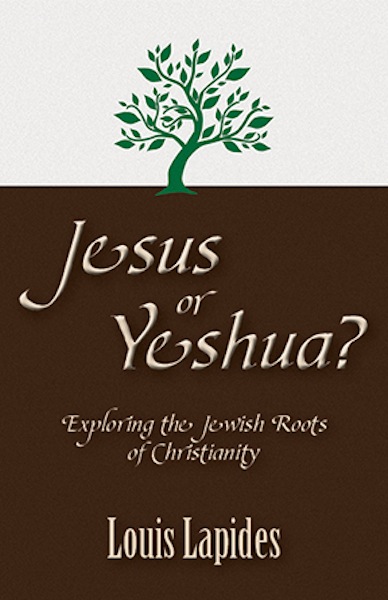
Today ScriptureSolutions published a new booklet written by Louis Lapides. This brief book can be found for Kindle at Amazon.
Jesus or Yeshua: Exploring the Jewish Roots of Christianity by Louis Lapides
It came to no surprise to me that when I first became a Jewish follower of Yeshua, I was going to have a cultural crisis trying to fit into a Gentile Church. I lasted a few months before I started asking inevitable questions, “I’m Jewish. Jesus is Jewish. His first followers were Jewish. The New Testament was written by Jews and a lot of the concepts they discussed have a powerful Hebraic background. Then why is Christianity so “not-Jewish”?
Jesus or Yeshua: Exploring the Jewish Roots of Christianityprovides the reader with some of the findings I came upon as searched for answers to my questions. For me a lot of the issues were resolved when I studied the origin of most of the terminology used by Christians when describing their beliefs and practices. When I was growing up attending Hebrew school in preparation for my Bar Mitzvah I never expected that Rabbi Printz would tell me that the mass practiced by the Catholic Church across the street from our temple was actually based in the Jewish Passover. Nor was I told that baptism has it’s origins in the Jewish practice of immersion or mikveh used when Gentiles would turn from their paganism and convert to Judaism.
Attending a church for me at age 23 was a shocker as I describe in my opening chapter. Here is a sample section from that chapter that will give you an idea of what Jesus or Yeshua: Exploring the Jewish Roots of Christianity is all about.
Here’s a shocker . . . Jewish people don’t feel at ease in a Christian church. The first time I attended a Protestant congregation, a Southern Baptist one, I couldn’t avert my eyes from the 10-foot tall stained glass mosaic of Jesus looming behind the pastor. I imagined for a few moments the man from Galilee was about to step out of the window, float over to my pew and ask whether I noticed the “Jews Not Welcome” sign at the church’s front door. “Of course,” I would respond, “But Jesus, aren’t you . . . .?”
At the recent Christ at the Checkpoint conference in Bethlehem, an array of pro-Palestinian Christian speakers shared their thoughts on the current status of the Palestinian Christian Church, their opposing views to Christian Zionism and their own theological stance commonly known as replacement theology. Munther Isaac, Instructor, Vice Academic Dean and Choir director at Bethlehem Bible College, delivered a message entitled, ” A Palestinian Christian Perspective” in which he referred to himself both as a person of Arab descent and since he is a follower of Jesus, claimed to be one of the “seed of Abraham.” Then in his message he took a theological leap to refer to himself as part of Israel, the true spiritual Israel.
The belief that Christians are members of the seed of Abraham is nothing new in Christendom. While several verses are found in the New Testament referring to followers of Jesus as the “seed of Abraham,” most evangelicals commit a theological error by referring to themselves as the “true Israel.”
It is my contention no verses exist in the New Testament can be found where Paul or any other New Testament writer refers to Gentiles as anything other as “gentiles.” Listen to Paul in Romans 1:5: Through him we received grace and apostleship to call all the Gentiles to the obedience that comes fro faith for his name’s sake. Then again in Romans 11:11: 11 “Again I ask: Did they stumble so as to fall beyond recovery? Not at all! Rather, because of their transgression, salvation has come to the Gentiles to make Israel envious.
In Romans 11:11 Paul makes a distinction between Gentiles who follow Jesus from Jewish people or members of the nation of Israel. In Romans 11:13 Paul speaks to gentile converts to Christ and refers to them as “gentiles” and not spiritual Jews or members of spiritual Israel: I am talking to you Gentiles. Inasmuch as I am the apostle to the Gentiles, I take pride in my ministry.
Once again Paul distinguishes Gentile followers from the Jewish people in Romans 15:27: They were pleased to do it, and indeed they owe it to them. For if the Gentiles have shared in the Jews’ spiritual blessings, they owe it to the Jews to share with them their material blessings. (more…)
Rich Stearns, president of Christian relief organization World Vision had spent a memorable meal with Palestinian Christians and 30 American pastors and church leaders in a cave west of Bethlehem. After the half mile hike to reach his destination at the top of a hillside, he was greeted by a sign that read, “We refuse to be enemies.”
The West Bank section of land where this Christian gathering took place is a mere 100 acres. However, its Palestinian residents, the Nassars have turned their property into an touch point for demonstrating to evangelical American Christians how unfairly Palestinian Christians are being treated by Israelis.
Here is a video made three weeks ago by Porter Speakman Jr, director of pro-Palestinian Christian film With God on Our Sideabout Nassar family. This video was recently aired at the Christ at the Checkpoint Conference at Bethlehem Bible College in Bethlehem.
The Nassars claim they have owned the land since 1916, and according to international law, the territory does not belong to Israel, but to the Nassar family. Currently, according to World Vision President Stearns, the parcel of land is surrounded by 50,000 Israeli settlers, “living on similar land confiscated from other Palestinian families.”




 my laptop at a variety of Starbuck locations, I am exposed to a myriad of conversations. Loud, obnoxious cell phone calls. Stodgy business conferences. Idle talk meetups. Annoying boardgame banter. I hear it all.