Nov 4, 2026
Posted by Scripture Solutions on Nov 4, 2026 | 0 comments
Introduction: Take Me Out to the Ball Game
Twelve years before I arrived in Southern California, the Brooklyn Dodgers also relocated to Los Angeles. After 68 seasons in Brooklyn, the Dodgers moved to Los Angeles on October 8, 1957. The baseball New York Giants also relocated to the Golden State after the 1957 season, becoming the San Francisco Giants to keep the historic Dodgers–Giants rivalry intact.
The Brooklyn Dodgers were renamed the Los Angeles Dodgers. Obviously, the LA Dodgers remained the same team as the Brooklyn Bums, as they were referred to. Now, Brooklyn and Los Angeles Dodgers fans share the same proud history. They both can brag about World Series wins in 1956, 1963, 1965, 1969, 1981, 1988, and so on.
Whether the World Series championship rings were won in NY or in LA, ALL Dodger fans celebrate these victories and the players who are part of the Dodger legacy.
When it comes to the connection between the nation of Israel and the New Testament Church, some replacement theologians argue the Jewish nation and the multi-ethnic Church are the same team. These Christian influencers advocate that the Church today is the “new Israel” or a “spiritual Israel.”
According to Replacement Theology, the Church is a spiritual entity that has superseded the physical nation of Israel and is now the newest version of Israel. To the supersessionist mindset, former Israel failed God as His chosen instrument. Hence, God moved His team from an ethnic, religious body of Abraham’s descendants to a spiritual body connected to Abraham by faith, NOT by nationality.
In the last two posts of this series, I want to focus on the thinking that has turned the Israelite Dodgers into the Universal Dodgers in the minds of many replacement theology advocates.
It boils down to hermeneutics, the art of applying interpretive skills to biblical passages, especially about God’s relationship to Israel and the Church. In previous posts, I defined hermeneutics and shared a few dynamics. In this post, I continue to flesh out key hermeneutical considerations that clarify the concerns about the Church’s relationship to Israel.
Is Israel the same entity as the Church, but now designated as a “spiritual Israel”? Or are they two distinct bodies of people, unified through the worship of the God of Israel?
Let’s find out.
An Essential Hermeneutical Map to Interpret Scripture
I have to initially ask: “Does Replacement theology (RT) grow out of the text of the Tenach? Another way to formulate my concern is to inquire whether Replacement theology is a top-down theological system. In this scheme, a student starts with a premise that he imposes on the biblical text.
In contrast, when an interpreter has consistent principles of biblical interpretation, he respects the text and lets his interpretation reflect it. An expert theologian begins with one premise: theology grows out of the biblical text, and is not forced onto a passage.
Therefore, every learner of Scripture must keep a few hermeneutical essentials in mind.
(more…)
Apr 20, 2012
Posted by Scripture Solutions on Apr 20, 2012 | 1 comment
Why am I writing so much about the seed of Abraham? After all, there are so many other issues that seem to be much more important when it comes to examining the Middle East crisis. Let me be bold enough to say that how a person understands the biblical teaching on the seed of Abraham, determines how much he will grasp the theological implications of the Middle East crisis.
Does the seed of Abraham only relate to Jewish people? Does it include Arabs and Christians as well? Can one support the idea that those who call themselves the seed of Abraham are no longer the “true seed of Abraham” if they refuse to accept Jesus? These are essential questions any student of the Bible must come to grips with. Too many erroneous sermons have been preached in the church concerning the identity of Israel causing confusion among churchgoers.
Unfortunately, this was one of the main issues espoused by Wheaton College NT professor Gary Burge in his recent lecture at the Christ at the Checkpoint Conference, “The Theology of the Land According to the New Testament.” However, in his lecture Burge hardly referred to the land of Israel but instead set his scope on casting a dubious hue on the identity of the Jewish people as the true seed of Abraham, and consequently no longer legitimate heirs of the Promised Land.
If a person can demonstrate that Jewish people today are not the true seed of Abraham, this teaching goes hand in hand with the belief God no longer has a present covenant with the Jewish people in which He has promised the Jewish people the Holy Land of Eretz Israel.
Burge, like many replacement theologians (the belief the Church has replaced Israel as God’s people), quotes a string of New Testament passages to support his view that DNA (aka Jewish ancestry) no longer matters, but faith is what matters most to God. Since Christians demonstrate true faith in the God of Israel by accepting the Jewish Messiah, then Christians must be the true seed of Abraham.
The next leap in Burge’s theology is to state even though the Jewish people are entitled to a homeland, there are no biblical covenants today that entitle them to this land. Because of their failure to accept Christ, they have forfeited the divine land rights to Israel. What we are seeing today is a secular movement of the Jews returning to the land, but without the blessing of God or the fulfillment of biblical prophecy.
The Christian Tradition of Adverus Judeos in Connection with John 8
One of the passages used throughout the history of Christian doctrine to prove Jewish people are not the true seed of Abraham is John 8. In fact, John 8 has been used by medieval theologians to teach that the Jewish people have been spawned by the devil. In John 8:44 Jesus tells the Jewish leaders He is speaking to that their father is the devil.
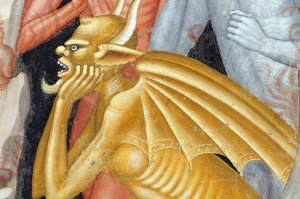
The devils display anti-Semitic stereotypes all too common in late medieval and early Renaissance art.
While Burge has not gone so far as to connect Jewish origins with the devil, he does use this passage to teach the Jewish people who do not believe in Jesus have been replaced by Christians.
Burge’s misinterpretation of John 8 puts him in the camp of those guilty of Adverus Judeos. Adverus Judeos is described in Wikipedia:
“Adversus Judaeos (Greek kata Ioudaious, “against the Jews” or “against the Judeans”) are a series of fourth century homilies by John Chrysostom (deemed a saint by the Roman Catholic and Eastern Orthodox churches) that have been circulated by many groups to foster antisemitism. Steven Katz cites Chrysostom’s homilies as “the decisive turn in the history of Christian anti-Judaism, a turn whose ultimate disfiguring consequence was enacted in the political antisemitism of Adolf Hitler”. James Parkes called the writing on Jews “the most horrible and violent denunciations of Judaism to be found in the writings of a Christian theologian”. His sermons against Jews gave further momentum to the idea that Jews are collectively responsible for the death of Jesus.”
While Burge does not harp on the collective responsibility of the death of Jesus by the Jewish people, his denial of their covenant entitlement to the land of Israel and their replacement as the “seed of Abraham” by Christians is all part of the same tradition of Adverus Judeos. (more…)